
GCSE Physics (AQA)
346 videos | 23 hours
Please subscribe to watch this video.
This, and all other videos, are included in our premium subscriptions.
Premium accounts get access to all videos.
Enable autoplay to keep watching
Your browser is blocking videos from playing automatically. To turn it back on:
Safari (Mac): Click the Safari menu item in the top bar, then Settings → Websites → Auto-Play, then set Auto-Play to Allow All Auto-Play for the current website.
Safari (iPhone/iPad): open the Settings app, then Apps → Safari → Auto-Play, and select Allow All Auto-Play.
Dynamo
- A dynamo is a simple electrical generator that produces direct current.
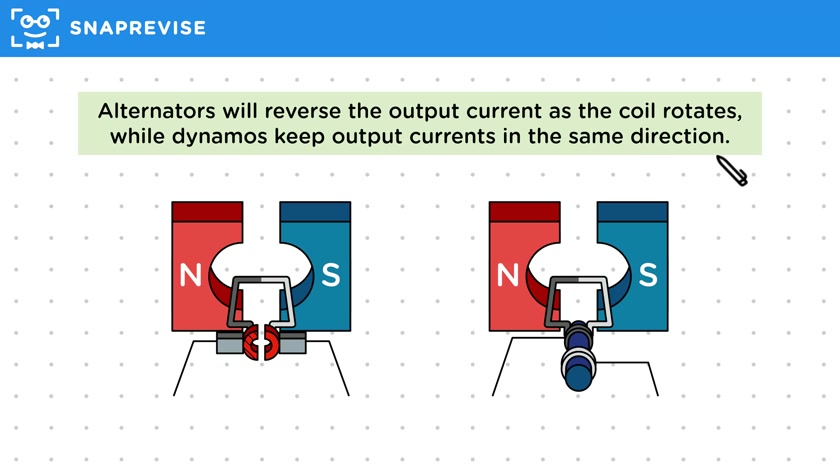
- General setup includes two magnetic poles with a magnetic field between them and a rectangular conducting coil.
- A split ring communicator connects the coil to wires leading to a circuit while allowing coil rotation.
- The coil is rotated externally to convert kinetic energy into electrical energy by inducing a current.
- The generator effect induces a potential difference and current through a conductor moving through a magnetic field.
- Dynamos produce direct current due to the split ring communicator keeping the current direction consistent.
- Alternators, in contrast, use two slip rings and produce alternating current by reversing the output current as the coil rotates.
- The main difference between dynamos and alternators is how they connect the coil to a circuit, affecting the current type.
- Dynamos keep the output current direction the same, while alternators reverse it.
- Potential difference graphs show dynamos have a bouncing pattern above the x-axis, while alternators' graphs go above and below the x-axis.
- Dynamos are used in devices like bicycle lamps and hand-crank flashlights or radios, replacing batteries with direct current generation.
- Devices powered by batteries use direct currents, while those powered by mains electricity use alternating currents.
Please subscribe to access these revision notes.
This, and all other video notes, are included in our premium subscriptions.
Premium accounts get access to all videos and revision notes.
99
questions for Magnetism and electromagnetism
38
questions for Induced potential, transformers and the National Grid (physics only) (HT only)