
GCSE Physics (AQA)
346 videos | 23 hours
Please subscribe to watch this video.
This, and all other videos, are included in our premium subscriptions.
Premium accounts get access to all videos.
Enable autoplay to keep watching
Your browser is blocking videos from playing automatically. To turn it back on:
Safari (Mac): Click the Safari menu item in the top bar, then Settings → Websites → Auto-Play, then set Auto-Play to Allow All Auto-Play for the current website.
Safari (iPhone/iPad): open the Settings app, then Apps → Safari → Auto-Play, and select Allow All Auto-Play.
Electric Motors
- An electric motor converts electrical energy to kinetic energy.
- Used in devices like electric drills and remote control cars.
- Electric motors should not be confused with piston motors.
- A simple current-carrying coil in a magnetic field performs half rotations.
- A rectangular coil in a magnetic field experiences forces causing rotation.
- The coil rotates counterclockwise due to forces on opposite sides.
- After half a rotation, the direction of current and forces switch.
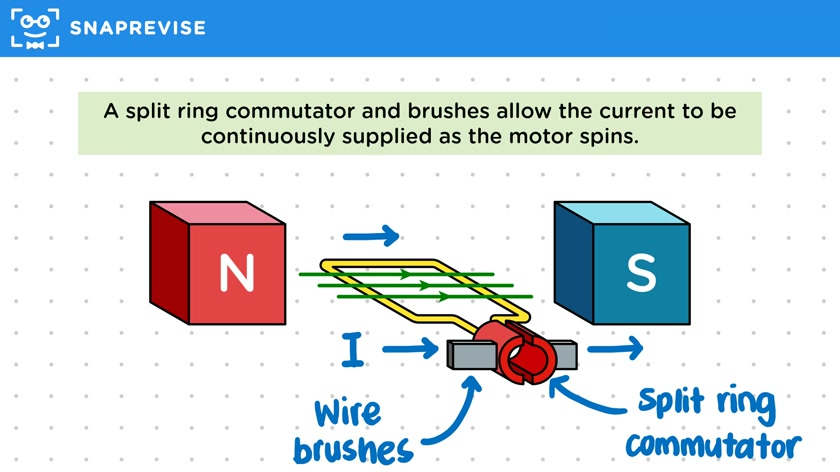
- A split ring commutator prevents change in rotation direction by swapping current direction every half rotation.
- The commutator and brushes allow continuous current supply as the motor spins.
- The split ring commutator consists of two halves, each in contact with different brushes.
- The direction of current through the coil changes every half turn.
- The split ring commutator allows the coil to spin continuously.
- The speed of rotation can be increased by increasing the current or using stronger magnets.
- The force from the motor effect depends on the size of the current and the magnetic field's flux density.
- A stronger power source or stronger magnets can increase the motor's speed.
Please subscribe to access these revision notes.
This, and all other video notes, are included in our premium subscriptions.
Premium accounts get access to all videos and revision notes.
99
questions for Magnetism and electromagnetism
41
questions for The motor effect