
GCSE Physics (AQA)
346 videos | 23 hours
Please subscribe to watch this video.
This, and all other videos, are included in our premium subscriptions.
Premium accounts get access to all videos.
Enable autoplay to keep watching
Your browser is blocking videos from playing automatically. To turn it back on:
Safari (Mac): Click the Safari menu item in the top bar, then Settings → Websites → Auto-Play, then set Auto-Play to Allow All Auto-Play for the current website.
Safari (iPhone/iPad): open the Settings app, then Apps → Safari → Auto-Play, and select Allow All Auto-Play.
Explaining Red-Shift
- Light waves experience the Doppler effect when a light source moves relative to an observer.
- The Doppler effect involves waves being stretched or squashed, changing their wavelength.
- Moving a light source towards an observer decreases the wavelength (blue shift).
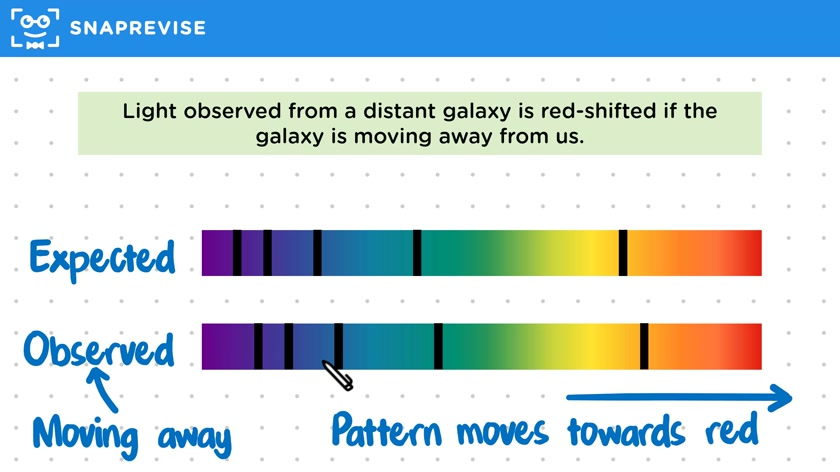
- Moving a light source away from an observer increases the wavelength (redshift).
- Redshift occurs when visible wavelengths shift towards the red end of the spectrum.
- Blue shift occurs when visible wavelengths shift towards the blue end of the spectrum.
- Redshift and blue shift are observed when analyzing light from distant galaxies and stars.
- Light from a galaxy moving away from us is redshifted.
- The Doppler effect explains why light from distant galaxies is redshifted.
- Analyzing light involves refracting it into an emission spectrum, where certain wavelengths may be missing.
- A redshifted emission spectrum indicates a galaxy moving away from us.
- The amount of redshift varies depending on the speed of the galaxy.
- Faster-moving galaxies cause a greater redshift effect.
- Emission spectra can be used to compare the motion of different galaxies.
- Blueshift effects are observed if a galaxy is moving towards us.
- There are few galaxies moving towards us in the universe.
- A blueshifted emission spectrum indicates a galaxy moving towards us.
- Understanding emission spectra is important for explaining galaxy motion in exams.
Please subscribe to access these revision notes.
This, and all other video notes, are included in our premium subscriptions.
Premium accounts get access to all videos and revision notes.
61
questions for Space physics (physics only)
19
questions for Red-shift (physics only)