
GCSE Physics (AQA)
346 videos | 23 hours
Please subscribe to watch this video.
This, and all other videos, are included in our premium subscriptions.
Premium accounts get access to all videos.
Enable autoplay to keep watching
Your browser is blocking videos from playing automatically. To turn it back on:
Safari (Mac): Click the Safari menu item in the top bar, then Settings → Websites → Auto-Play, then set Auto-Play to Allow All Auto-Play for the current website.
Safari (iPhone/iPad): open the Settings app, then Apps → Safari → Auto-Play, and select Allow All Auto-Play.
Explosions & Recoil
- An explosion provides a force that pushes objects away from the point of origin.
- An example of an explosion is a bomb, which releases a large amount of energy from a chemical reaction.
- The explosion creates an outward force that pushes everything away from the point of the explosion.
- Shrapnel, or small pieces of material, are projected away from the bomb during the explosion.
- Particles in an explosion are objects with mass, but their shape or volume is not considered.
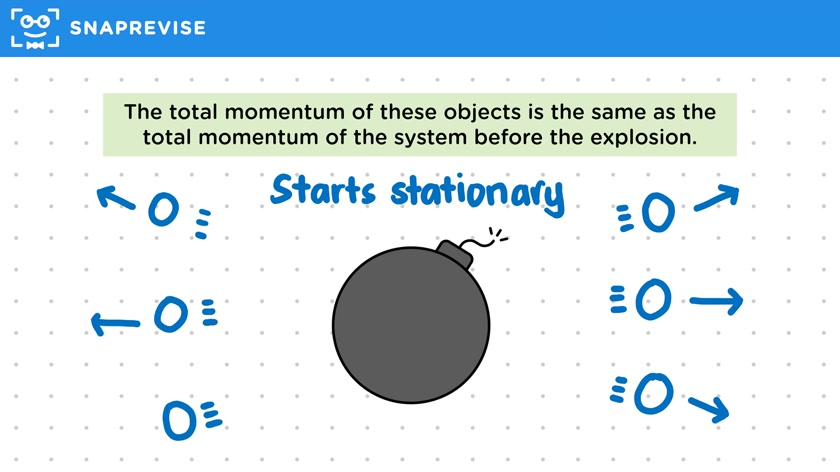
- The total momentum of the particles after an explosion is the same as the total momentum before the explosion.
- Momentum is the product of mass and velocity and is conserved unless an external force acts on the system.
- A bomb and its shrapnel can be treated as a closed system, with the explosion as the only force.
- If the bomb was stationary before the explosion, the total momentum was zero.
- After the explosion, the vector sum of all particle momentum adds to zero, conserving momentum.
- Momentum acts as a vector; momentum in one direction is canceled by momentum in the opposite direction.
- In exams, one-dimensional examples with two or three particles are common.
- A gun recoils when fired to balance the momentum of the fired bullet.
- The gun is initially stationary; firing causes the bullet to gain momentum, P.
- The gun recoils with the same momentum, P, in the opposite direction.
- Momentum vectors are equal and opposite, adding to zero, conserving system momentum after the explosion.
Please subscribe to access these revision notes.
This, and all other video notes, are included in our premium subscriptions.
Premium accounts get access to all videos and revision notes.
153
questions for Forces
32
questions for Momentum (HT only)