
GCSE Physics (AQA)
346 videos | 23 hours
Please subscribe to watch this video.
This, and all other videos, are included in our premium subscriptions.
Premium accounts get access to all videos.
Enable autoplay to keep watching
Your browser is blocking videos from playing automatically. To turn it back on:
Safari (Mac): Click the Safari menu item in the top bar, then Settings → Websites → Auto-Play, then set Auto-Play to Allow All Auto-Play for the current website.
Safari (iPhone/iPad): open the Settings app, then Apps → Safari → Auto-Play, and select Allow All Auto-Play.
Force & Change of Momentum
- A resultant force on a stationary object causes it to gain momentum.
- Resultant force occurs when forces on an object are unbalanced, expressed as a single force.
- Example: A stationary billiard ball gains momentum when hit by a cue.
- Momentum is the product of mass and velocity; gaining velocity means gaining momentum.
- Total momentum in a system cannot change; Newton's third law states equal and opposite reaction forces.
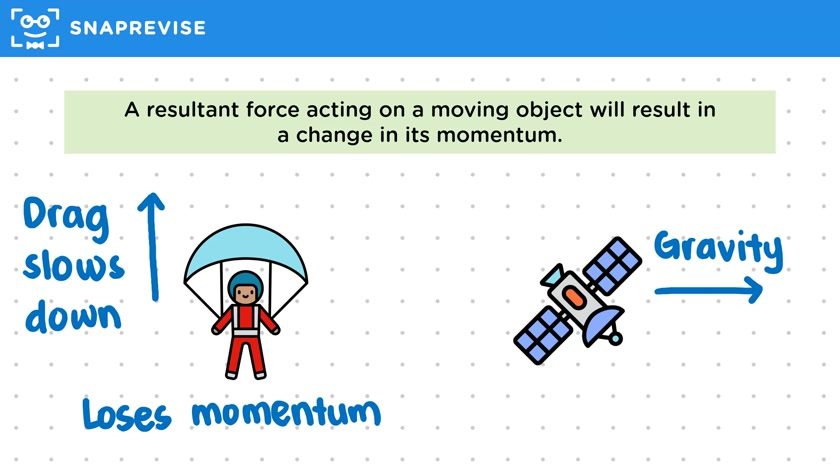
- Resultant force on a moving object changes its momentum.
- Example 1: A skydiver loses momentum when a parachute opens, slowing them down.
- Example 2: A satellite's direction changes due to gravity, altering its momentum.
- Momentum is a vector with magnitude and direction; change in direction changes momentum.
- Change in momentum increases with stronger force or longer application time.
- Example: A car slows down by applying a braking force, losing momentum.
- Stronger brakes or longer brake application increases momentum loss.
- Understanding forces and momentum changes is crucial for analyzing examples.
Please subscribe to access these revision notes.
This, and all other video notes, are included in our premium subscriptions.
Premium accounts get access to all videos and revision notes.
153
questions for Forces
32
questions for Momentum (HT only)