
GCSE Physics (AQA)
346 videos | 23 hours
Please subscribe to watch this video.
This, and all other videos, are included in our premium subscriptions.
Premium accounts get access to all videos.
Enable autoplay to keep watching
Your browser is blocking videos from playing automatically. To turn it back on:
Safari (Mac): Click the Safari menu item in the top bar, then Settings → Websites → Auto-Play, then set Auto-Play to Allow All Auto-Play for the current website.
Safari (iPhone/iPad): open the Settings app, then Apps → Safari → Auto-Play, and select Allow All Auto-Play.
Force-Momentum Equation
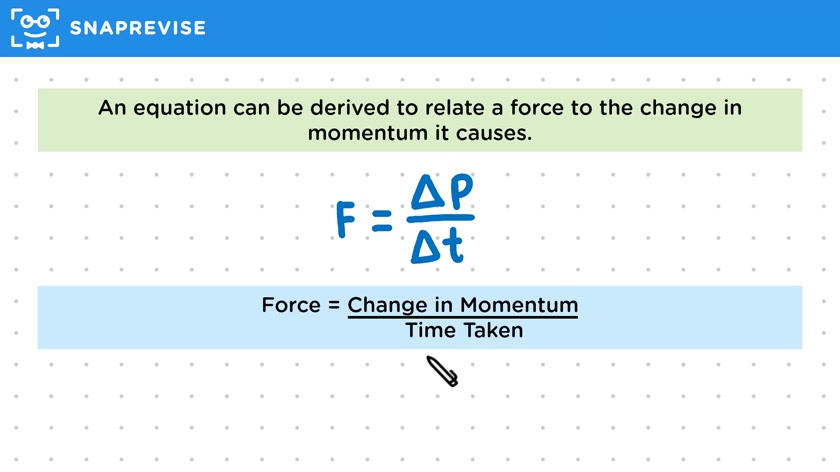
- An equation can relate force to the change in momentum.
- Understanding how to calculate a change in momentum is crucial.
- Momentum is given by mass times velocity (P = M * V).
- Change in momentum is the difference between starting and final momentum (P end - P start).
- This can be expressed as MV - MU, and factorized to M(V - U).
- Simplified, this is delta P = M * delta V, where delta represents change.
- Newton's second law states force equals mass times acceleration (F = MA).
- Acceleration is the rate of change of velocity (A = delta V / delta T).
- Substituting acceleration in the force equation gives F = M * delta V / delta T.
- M * delta V is equivalent to delta P, so F = delta P / delta T.
- This means force equals the change in momentum divided by the time taken.
- The resultant force determines the rate of change of momentum.
- At GCSE level, understanding the derivation from F = MA and momentum definition is important.
- Units: momentum in kg m/s, time in seconds, force in Newtons.
- Newtons are equivalent to kg m/s��.
- Example: Calculate average force for a parachutist reducing momentum from 4000 to 600 kg m/s in 1.2 seconds.
- Steps: Write key values, calculate change in momentum, calculate average force, round answer.
- Change in momentum: 600 - 4000 = -3400 kg m/s (negative indicates opposite force direction).
- Average force: 3400 / 1.2 = 2833.33 Newtons.
- Round to two significant figures: 2800 Newtons.
Please subscribe to access these revision notes.
This, and all other video notes, are included in our premium subscriptions.
Premium accounts get access to all videos and revision notes.
321
questions for Forces
32
questions for Momentum (HT only)