
GCSE Physics (AQA)
346 videos | 23 hours
Please subscribe to watch this video.
This, and all other videos, are included in our premium subscriptions.
Premium accounts get access to all videos.
Enable autoplay to keep watching
Your browser is blocking videos from playing automatically. To turn it back on:
Safari (Mac): Click the Safari menu item in the top bar, then Settings → Websites → Auto-Play, then set Auto-Play to Allow All Auto-Play for the current website.
Safari (iPhone/iPad): open the Settings app, then Apps → Safari → Auto-Play, and select Allow All Auto-Play.
Forces in Transport
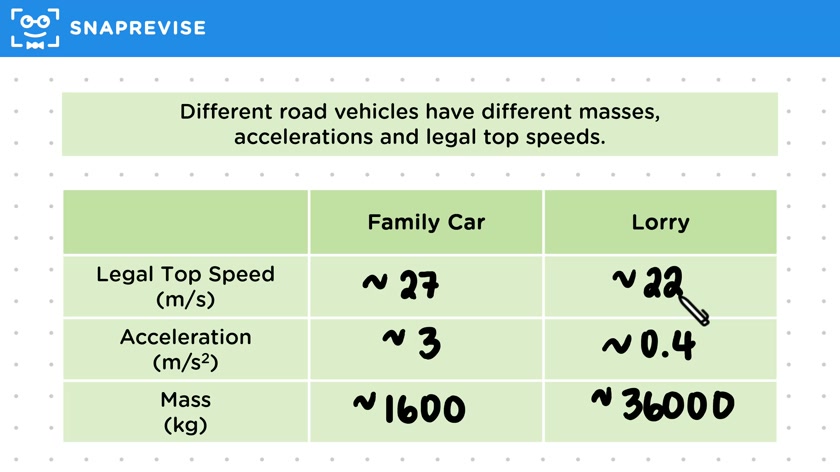
- Different road vehicles have different masses, accelerations, and legal top speeds.
- Comparison between a typical four-seater family car and a large lorry.
- Legal top speeds on a British motorway: car ~27 m/s (70 mph), lorry ~22 m/s (60 mph).
- Lorry has a harder time reaching higher speeds due to lower acceleration.
- Car acceleration: ~3 m/s��; Lorry acceleration: ~0.4 m/s��.
- Lorry maintains a smaller speed for safety reasons.
- Mass difference: Car ~1,600 kg; Lorry ~36,000 kg.
- Estimation of forces needed to accelerate vehicles to top speed using Newton's second law (Force = Mass x Acceleration).
- Force for car: ~4,800 Newtons (1,600 kg x 3 m/s��).
- Force for lorry: ~14,400 Newtons (36,000 kg x 0.4 m/s��).
- Lorry requires a more powerful engine due to its mass.
- Ability to estimate sensible values for vehicle speeds, forces, and calculate them from estimated masses and accelerations is important.
Please subscribe to access these revision notes.
This, and all other video notes, are included in our premium subscriptions.
Premium accounts get access to all videos and revision notes.
153
questions for Forces
98
questions for Forces and motion