
GCSE Physics (AQA)
346 videos | 23 hours
Please subscribe to watch this video.
This, and all other videos, are included in our premium subscriptions.
Premium accounts get access to all videos.
Enable autoplay to keep watching
Your browser is blocking videos from playing automatically. To turn it back on:
Safari (Mac): Click the Safari menu item in the top bar, then Settings → Websites → Auto-Play, then set Auto-Play to Allow All Auto-Play for the current website.
Safari (iPhone/iPad): open the Settings app, then Apps → Safari → Auto-Play, and select Allow All Auto-Play.
Forces
Moments, levers and gears (physics only)
Forces & Rotation
2:29
Moments
Spec
4.5.4
- Forces can cause objects to rotate about a pivot.
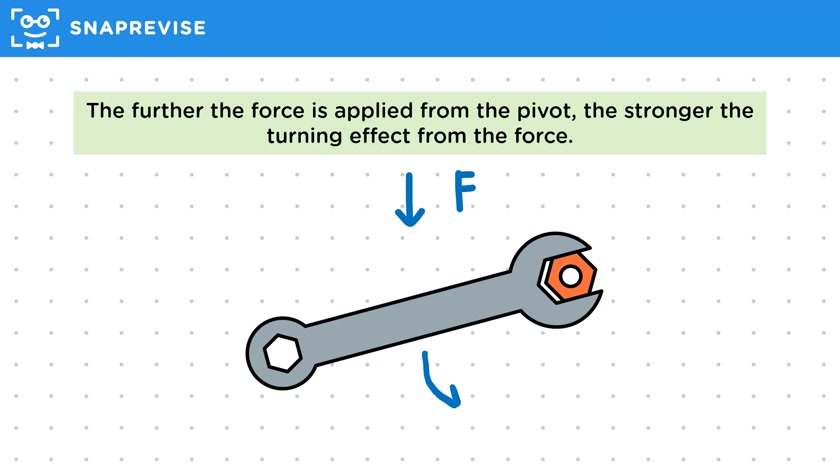
- A wrench and nut are examples of rotation, with the nut as the pivot.
- The wrench rotates when force is applied at the opposite end of the pivot.
- In exams, turning force examples will have a clear pivot point.
- Force should be applied away from the pivot for rotation.
- No rotation occurs if force is applied at the pivot point.
- The further the force is from the pivot, the stronger the turning effect.
- Less rotation occurs when force is applied closer to the pivot.
- More rotation occurs when force is applied further from the pivot.
- Wrench design ideally has a long handle for more rotation.
- Other examples of forces causing rotation include doors, seesaws, and spanners.
- Door handles are placed far from the hinge (pivot) for effective rotation.
- On a seesaw, the pivot is at the center with opposite forces applied at either end.
- On a spanner, the pivot is at the center with opposite forces applied at either end.
- Understanding turning effects is important for explaining similar examples in exams.
Please subscribe to access these revision notes.
This, and all other video notes, are included in our premium subscriptions.
Premium accounts get access to all videos and revision notes.
Report an Issue
Spotted something wrong? Let us know and we'll take a look.