
GCSE Physics (AQA)
346 videos | 23 hours
Please subscribe to watch this video.
This, and all other videos, are included in our premium subscriptions.
Premium accounts get access to all videos.
Enable autoplay to keep watching
Your browser is blocking videos from playing automatically. To turn it back on:
Safari (Mac): Click the Safari menu item in the top bar, then Settings → Websites → Auto-Play, then set Auto-Play to Allow All Auto-Play for the current website.
Safari (iPhone/iPad): open the Settings app, then Apps → Safari → Auto-Play, and select Allow All Auto-Play.
Forming Images
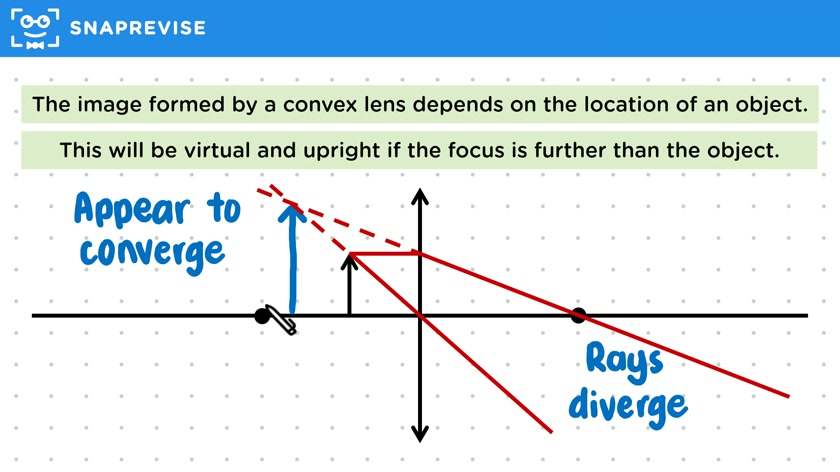
- The image formed by a convex lens depends on the object's location.
- Lenses form images by refracting light from an object.
- A convex lens curves outwards, causing parallel rays to converge.
- The principle axis is a line through the center of the lens where rays don't refract.
- The image is real and inverted if the object is further than the focus.
- The focus is the point where rays parallel to the principle axis converge.
- A convex lens has a principle focus on either side.
- Ray diagrams use three key rays: through the lens center, parallel to the axis then through the focus, and through the focus then parallel to the axis.
- If the object is between the focus and the lens, the image is virtual and upright.
- Concave lenses only form virtual upright images regardless of object location.
- Concave lenses curve inwards, causing parallel light rays to diverge.
- For concave lenses, rays parallel to the principle axis appear to pass through a virtual focus.
- A table can summarize lens types and image properties:
- Convex lens: real inverted image if object is further than focus; virtual upright image if closer.
- Concave lens: always virtual upright image.
- Understanding lens behavior helps predict image types before constructing ray diagrams.
Please subscribe to access these revision notes.
This, and all other video notes, are included in our premium subscriptions.
Premium accounts get access to all videos and revision notes.
172
questions for Waves
81
questions for Electromagnetic waves