
GCSE Physics (AQA)
346 videos | 23 hours
Please subscribe to watch this video.
This, and all other videos, are included in our premium subscriptions.
Premium accounts get access to all videos.
Enable autoplay to keep watching
Your browser is blocking videos from playing automatically. To turn it back on:
Safari (Mac): Click the Safari menu item in the top bar, then Settings → Websites → Auto-Play, then set Auto-Play to Allow All Auto-Play for the current website.
Safari (iPhone/iPad): open the Settings app, then Apps → Safari → Auto-Play, and select Allow All Auto-Play.
Gradient of a Force-Extension Graph
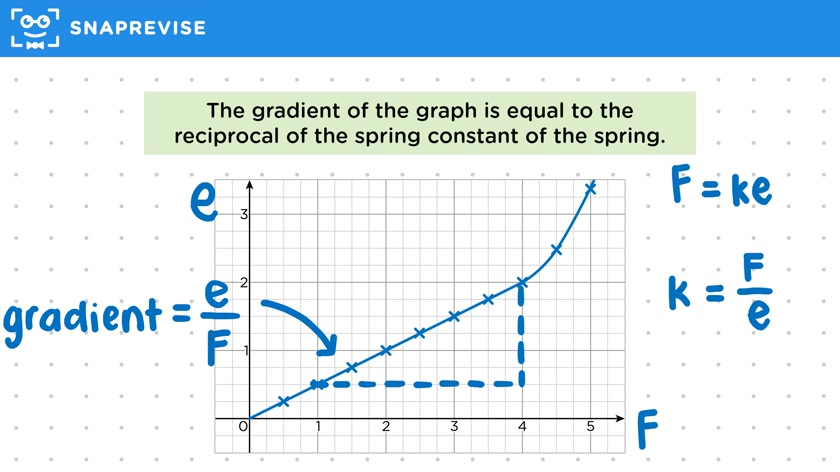
- Before the limit of proportionality, the extension of a spring is proportional to the force applied.
- A force extension graph can be created by plotting extension on the Y axis and force on the X axis.
- The graph shows that force and extension are proportional; doubling one value doubles the other.
- The limit of proportionality is the force after which inelastic deformations occur, and force and extension are no longer proportional.
- The gradient of the graph is equal to the reciprocal of the spring constant.
- To calculate the gradient, choose two points and find the difference in Y and X.
- The gradient is the difference in extension (E) over the difference in force (F).
- Before the limit of proportionality, F = KE, where K is the spring constant.
- K is equal to F over E, so flip the gradient to get the equation for K.
- In exams, use this method to calculate the spring constant from a graph.
- Example: Various weights are hung from a spring, and extension is measured and plotted on a graph.
- To calculate the spring constant, choose two points: 7.5 N and 0.9 m, 2.5 N and 0.3 m.
- Divide the difference in force by the difference in extension: (7.5 - 2.5) / (0.9 - 0.3) = 8.333 recurring.
- Round the result to two significant figures: 8.3 N/m.
Please subscribe to access these revision notes.
This, and all other video notes, are included in our premium subscriptions.
Premium accounts get access to all videos and revision notes.
153
questions for Forces
1
questions for Forces and elasticity