
GCSE Physics (AQA)
346 videos | 23 hours
Please subscribe to watch this video.
This, and all other videos, are included in our premium subscriptions.
Premium accounts get access to all videos.
Enable autoplay to keep watching
Your browser is blocking videos from playing automatically. To turn it back on:
Safari (Mac): Click the Safari menu item in the top bar, then Settings → Websites → Auto-Play, then set Auto-Play to Allow All Auto-Play for the current website.
Safari (iPhone/iPad): open the Settings app, then Apps → Safari → Auto-Play, and select Allow All Auto-Play.
Hazards & Half Lives
- Half-life determines the activity and stability duration of a radioactive source.
- Half-life is the time it takes for half of the radioactive nuclei in a sample to decay.
- Iodine-131 and Cesium-137 contaminated the environment after Chernobyl and Fukushima disasters.
- Iodine-131 has a short half-life of 8 days; Cesium-137 has a long half-life of 30 years.
- Half-life affects the nature of the hazard presented by radioactive sources.
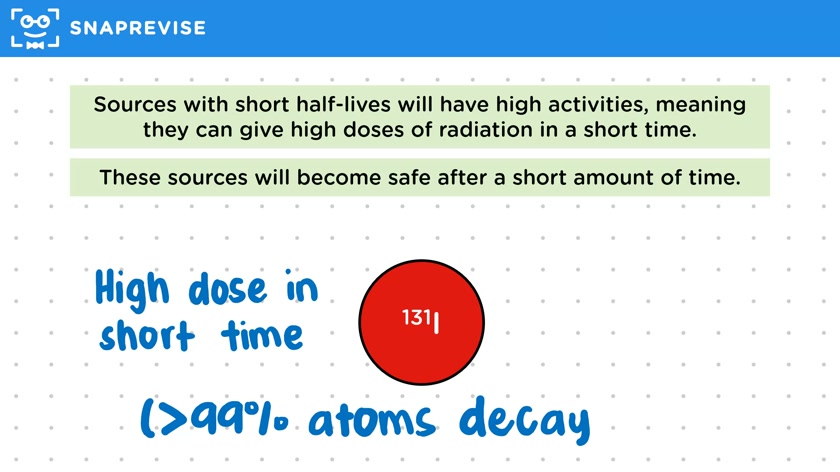
- Sources with short half-lives have high activities, giving high radiation doses in a short time.
- These sources become safe after 99% of atoms decay, typically after seven half-lives.
- Iodine-131 becomes safe quickly, in about two months.
- Sources with long half-lives have low activities, giving low doses over a short time.
- Long half-life sources contaminate surroundings for a long time, taking longer to become stable.
- Cesium-137 remains unstable for over 100 years, emitting radiation for a long time.
- In exams, you may need to compare risks of different radiation sources based on their half-lives.
Please subscribe to access these revision notes.
This, and all other video notes, are included in our premium subscriptions.
Premium accounts get access to all videos and revision notes.
137
questions for Atomic structure
26
questions for Hazards and uses of radioactive emissions and of background radiation (physics only)