
GCSE Physics (AQA)
346 videos | 23 hours
Please subscribe to watch this video.
This, and all other videos, are included in our premium subscriptions.
Premium accounts get access to all videos.
Enable autoplay to keep watching
Your browser is blocking videos from playing automatically. To turn it back on:
Safari (Mac): Click the Safari menu item in the top bar, then Settings → Websites → Auto-Play, then set Auto-Play to Allow All Auto-Play for the current website.
Safari (iPhone/iPad): open the Settings app, then Apps → Safari → Auto-Play, and select Allow All Auto-Play.
Hydraulic Calculations
- Pressure input to a hydraulic system equals pressure output.
- Hydraulic systems transfer pressures through incompressible liquids, aiding in force transfer and amplification.
- In hydraulic calculations, input pressure equals output pressure due to consistent pressure throughout the liquid.
- Example: A hydraulic lift uses input force on a pedal to raise a platform.
- Input force is applied to the pedal, and output force is exerted by the liquid on the platform.
- Pressure is calculated as force divided by area.
- Input force/area equals output force/area.
- Key to solving hydraulics problems: identify input/output forces and areas, and maintain pressure relation.
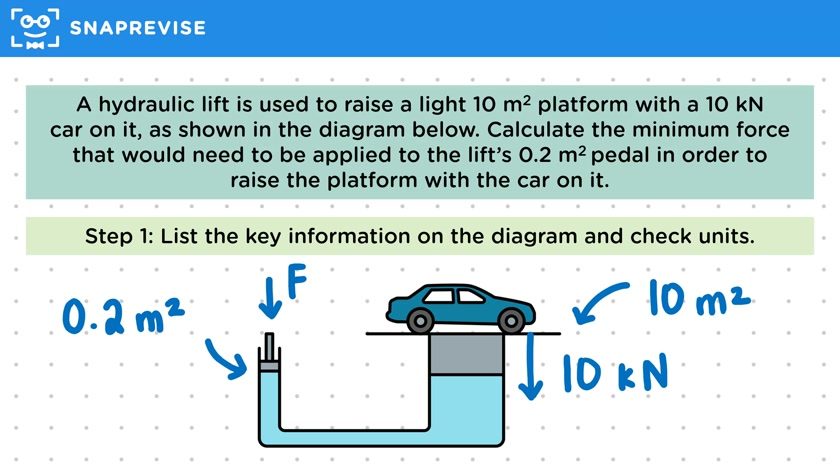
- Example calculation: Hydraulic lift raises a 10m�� platform with a 10 kN car.
- Calculate minimum force on a 0.2m�� pedal to lift the platform.
- Step 1: List key information and check units.
- Input: pedal area 0.2m��, Output: platform area 10m��, car weight 10 kN.
- Minimum upward force needed equals car weight (10,000 N).
- Step 2: Calculate pressure exerted by car on platform.
- Pressure = force/area; car exerts 1000 pascals on platform.
- Step 3: Determine pressure needed on pedal to overcome car's weight.
- Input pressure must equal output pressure (1000 pascals).
- Step 4: Rearrange pressure equation to solve for force.
- Force = pressure �� area.
- Step 5: Substitute values to calculate force.
- Pedal area 0.2m��, pressure 1000 pascals; force needed is 200 newtons.
- Small force required to raise heavy car due to hydraulic system efficiency.
Please subscribe to access these revision notes.
This, and all other video notes, are included in our premium subscriptions.
Premium accounts get access to all videos and revision notes.
153
questions for Forces
19
questions for Pressure and pressure differences in fluids (physics only)