
GCSE Physics (AQA)
346 videos | 23 hours
Please subscribe to watch this video.
This, and all other videos, are included in our premium subscriptions.
Premium accounts get access to all videos.
Enable autoplay to keep watching
Your browser is blocking videos from playing automatically. To turn it back on:
Safari (Mac): Click the Safari menu item in the top bar, then Settings → Websites → Auto-Play, then set Auto-Play to Allow All Auto-Play for the current website.
Safari (iPhone/iPad): open the Settings app, then Apps → Safari → Auto-Play, and select Allow All Auto-Play.
Kinetic Energy
- Kinetic energy is the energy stored in a moving object.
- Examples include a running hare and a falling apple, both of which gain kinetic energy through movement.
- Kinetic energy (KE) is calculated based on an object's mass and speed, using the formula KE = 0.5 * m * v^2, where:
- m = mass in kilograms
- v = speed in meters per second
- KE = kinetic energy in joules
- Direction of movement does not affect kinetic energy, hence speed is used in the formula instead of velocity.
- The formula for kinetic energy is provided in exams, but students need to know how to rearrange and apply it.
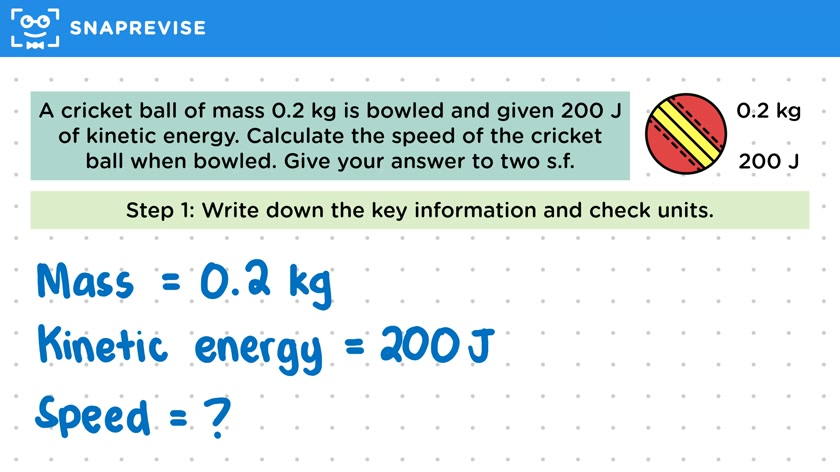
- Example problem: Calculate the speed of a 0.2 kg cricket ball given 200 joules of kinetic energy.
- Rearrange the kinetic energy formula to isolate v^2 (v^2 = 2KE/m).
- Take the square root of both sides to solve for v.
- Substitute values into the rearranged formula to find v = sqrt(2 * 200 / 0.2) = 44.7213 m/s.
- Round the calculated speed to two significant figures, resulting in 45 m/s.
Please subscribe to access these revision notes.
This, and all other video notes, are included in our premium subscriptions.
Premium accounts get access to all videos and revision notes.
153
questions for Forces
3
questions for Work done and energy transfer