
GCSE Physics (AQA)
346 videos | 23 hours
Please subscribe to watch this video.
This, and all other videos, are included in our premium subscriptions.
Premium accounts get access to all videos.
Enable autoplay to keep watching
Your browser is blocking videos from playing automatically. To turn it back on:
Safari (Mac): Click the Safari menu item in the top bar, then Settings → Websites → Auto-Play, then set Auto-Play to Allow All Auto-Play for the current website.
Safari (iPhone/iPad): open the Settings app, then Apps → Safari → Auto-Play, and select Allow All Auto-Play.
Loudspeakers
- Loudspeakers and headphones convert alternating current into sound waves using the motor effect.
- Both devices operate on the same principles, with headphones being a smaller scale version.
- Alternating current is supplied to the speaker, which constantly changes direction.
- The speaker converts electrical energy into sound waves, which travel as vibrations of air molecules.
- Speakers are a key application of magnets, often explained in exams.
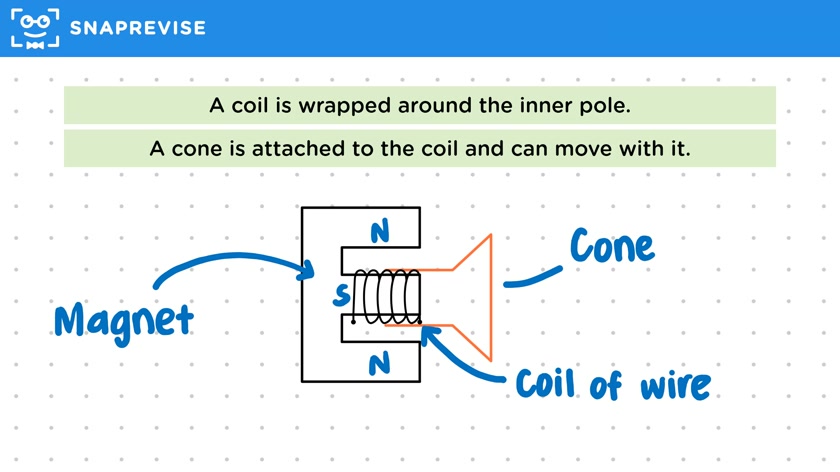
- Loudspeakers use a special magnet with two circular poles, creating a magnetic field from the outside to the center or vice versa.
- A coil is wrapped around the inner pole of the magnet and connected to a circuit to carry the alternating current.
- A cone, or diaphragm, is attached to the coil and moves with it, usually made of paper or thin material.
- The alternating current causes the motor effect, resulting in a force on the coil that alternates directions rapidly.
- The motor effect occurs when a wire carrying a current perpendicular to the magnetic field experiences a force.
- The coil experiences a force along the pole, changing direction as the current changes direction.
- This causes the coil and attached cone to oscillate back and forth, creating oscillations similar to vibrations.
- The oscillations of the cone cause pressure variations in the surrounding air, producing sound waves.
- The cone is shaped to push air molecules rhythmically, creating sound waves.
- The frequency of the sound waves matches the frequency of the alternating current.
- A stronger current results in more air disturbance, creating louder sounds.
Please subscribe to access these revision notes.
This, and all other video notes, are included in our premium subscriptions.
Premium accounts get access to all videos and revision notes.
99
questions for Magnetism and electromagnetism
41
questions for The motor effect