
GCSE Physics (AQA)
346 videos | 23 hours
Please subscribe to watch this video.
This, and all other videos, are included in our premium subscriptions.
Premium accounts get access to all videos.
Enable autoplay to keep watching
Your browser is blocking videos from playing automatically. To turn it back on:
Safari (Mac): Click the Safari menu item in the top bar, then Settings → Websites → Auto-Play, then set Auto-Play to Allow All Auto-Play for the current website.
Safari (iPhone/iPad): open the Settings app, then Apps → Safari → Auto-Play, and select Allow All Auto-Play.
Measuring Speed of Sound - Echoes
- Loud sound waves can reflect off large surfaces like buildings, cliffs, mountains, and cave walls to create echoes.
- An echo is formed when a sound wave is projected towards a surface, reflects off it without being absorbed, and travels back with unchanged speed, wavelength, and frequency, although its amplitude might decrease.
- If the reflected sound wave reaches the listener, they hear the original sound as an echo.
- Understanding echoes is important for exams, where students might need to recall what a reflected sound wave is known as or describe methods to measure the speed of sound using echoes.
- A method to measure the speed of sound using echoes involves several steps:
- 1. Measure the distance to the reflecting surface (e.g., a building) ensuring it's not too far to prevent hearing the echo or too close to receive the echo too quickly.
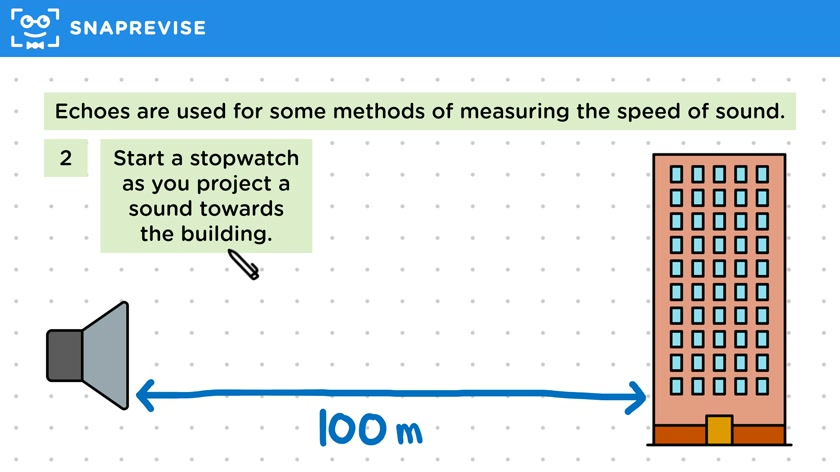
- 2. Start a stopwatch as you project a sound towards the building using a loud noise like yelling or an air horn.
- 3. Stop the stopwatch as soon as the echo is heard.
- 4. Halve the recorded time to determine the time it took for the sound to reach the building, considering the sound travels the distance twice (to the building and back).
- 5. Calculate the speed of sound by dividing the distance by the time it took for the sound to travel to the building.
- The speed of sound can be calculated as approximately 330 meters per second if it takes about 0.3 seconds to travel 100 meters.
- In exams, students might need to perform similar calculations or suggest methods to improve the accuracy of such measurements, like averaging the times of multiple echoes.
Please subscribe to access these revision notes.
This, and all other video notes, are included in our premium subscriptions.
Premium accounts get access to all videos and revision notes.
172
questions for Waves
72
questions for Waves in air, fluids and solids