
GCSE Physics (AQA)
346 videos | 23 hours
Please subscribe to watch this video.
This, and all other videos, are included in our premium subscriptions.
Premium accounts get access to all videos.
Enable autoplay to keep watching
Your browser is blocking videos from playing automatically. To turn it back on:
Safari (Mac): Click the Safari menu item in the top bar, then Settings → Websites → Auto-Play, then set Auto-Play to Allow All Auto-Play for the current website.
Safari (iPhone/iPad): open the Settings app, then Apps → Safari → Auto-Play, and select Allow All Auto-Play.
Microphones
- Microphones use the generator effect to convert sound wave pressure changes into current variations.
- To effectively use a microphone, it should be positioned so sound waves travel directly towards it.
- Sound waves are created by the back-and-forth vibrations of air particles.
- The microphone detects these vibrations and converts them into electrical current.
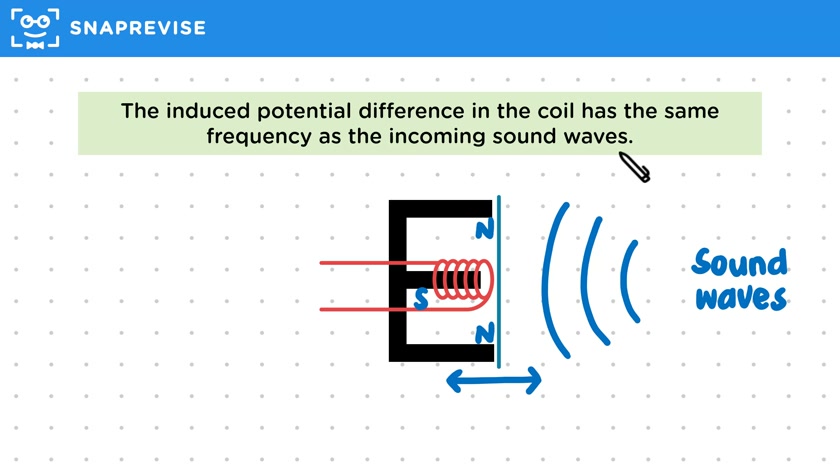
- The microphone contains a coil attached to a pressure-sensitive diaphragm that vibrates in response to sound waves.
- The diaphragm is a thin film that vibrates due to pressure changes and is connected to a coil of conducting wire.
- The coil is placed around the poles of a magnet, inducing a potential difference in the coil as it vibrates.
- The magnet has a north pole on the outside and a south pole in the center, creating a magnetic field directed towards the center.
- As the coil moves back and forth due to sound waves, it cuts across the magnetic field lines, inducing a potential difference.
- The induced potential difference and the resulting current have the same frequency as the incoming sound waves.
- The direction of the induced potential difference reverses with the direction of the coil's motion, creating an alternating potential difference and current.
- This alternating current carries the properties of the original sound waves and can be used in various applications.
- Microphones can send electrical signals to circuits, which can be used as inputs for loudspeakers or analyzed with oscilloscopes to display sound properties like frequency and amplitude.
- Loudspeakers convert electrical signals back into sound waves using the motor effect, often used in concerts and events.
- Oscilloscopes analyze the electrical signal from microphones to display sound wave properties.
- Microphones are also used for making audio recordings and as sound detectors.
Please subscribe to access these revision notes.
This, and all other video notes, are included in our premium subscriptions.
Premium accounts get access to all videos and revision notes.
99
questions for Magnetism and electromagnetism
38
questions for Induced potential, transformers and the National Grid (physics only) (HT only)