
GCSE Physics (AQA)
346 videos | 23 hours
Please subscribe to watch this video.
This, and all other videos, are included in our premium subscriptions.
Premium accounts get access to all videos.
Enable autoplay to keep watching
Your browser is blocking videos from playing automatically. To turn it back on:
Safari (Mac): Click the Safari menu item in the top bar, then Settings → Websites → Auto-Play, then set Auto-Play to Allow All Auto-Play for the current website.
Safari (iPhone/iPad): open the Settings app, then Apps → Safari → Auto-Play, and select Allow All Auto-Play.
Momentum
- Momentum of a moving object is defined as the product of its mass and velocity.
- Momentum is a fundamental concept in physics, especially at higher levels.
- The key equation for momentum at the GCSE level is momentum (P) equals mass (M) multiplied by velocity (V), expressed as P = M x V.
- This equation is not included on the formula sheet, but related equations involving the MV term are present.
- Momentum is a measure of how heavy and fast an object is moving.
- Units of momentum are kilograms meters per second (kg m/s), without a specific name for the combined unit.
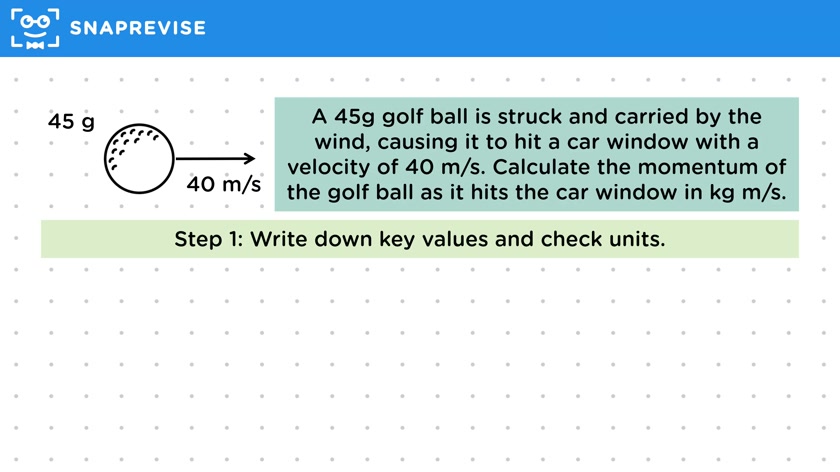
- Example provided: Calculating the momentum of a 45 gram golf ball moving at 40 meters per second as it hits a car window, requiring conversion of mass from grams to kilograms.
- The momentum calculation involves substituting the values into the formula, resulting in 1.8 kg m/s for the golf ball.
- Momentum comparison: Faster and more massive objects have greater momentum than slower and less massive objects.
- Increasing either mass or velocity will result in an increase in momentum.
Please subscribe to access these revision notes.
This, and all other video notes, are included in our premium subscriptions.
Premium accounts get access to all videos and revision notes.
153
questions for Forces
32
questions for Momentum (HT only)