
GCSE Physics (AQA)
346 videos | 23 hours
Please subscribe to watch this video.
This, and all other videos, are included in our premium subscriptions.
Premium accounts get access to all videos.
Enable autoplay to keep watching
Your browser is blocking videos from playing automatically. To turn it back on:
Safari (Mac): Click the Safari menu item in the top bar, then Settings → Websites → Auto-Play, then set Auto-Play to Allow All Auto-Play for the current website.
Safari (iPhone/iPad): open the Settings app, then Apps → Safari → Auto-Play, and select Allow All Auto-Play.
Atomic structure
Nuclear fission and fusion (physics only)
Nuclear Fusion
3:00
Nuclear fission
Spec
4.4.4.1
- Nuclear fusion involves two smaller nuclei joining to form a larger nucleus.
- Example: Two deuterium nuclei can fuse to become a helium nucleus.
- Fusion is difficult due to electrostatic repulsion between positively charged nuclei.
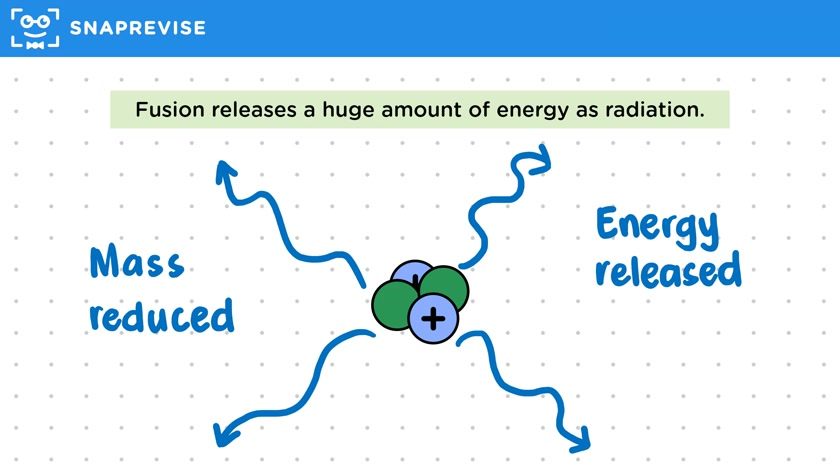
- Fusion releases a large amount of energy as radiation.
- The mass of the helium nucleus is less than the sum of the two deuterium nuclei, releasing energy due to mass difference.
- Energy from fusion is much greater than from fission.
- Hydrogen atoms in a glass of water could power a town for a month.
- Stars, like the sun, provide conditions for fusion due to intense temperature and pressure.
- Gravity and energy from fusion reactions create necessary conditions in stars.
- Fusion is not yet a viable energy resource on Earth due to energy input requirements.
- Research is ongoing to make fusion a viable energy source.
- Fusion in stars involves hydrogen and other atoms, releasing energy.
- Energy from fusion reactions in the sun supports food chains on Earth.
- Other fusion reactions occur during the death or expansion of stars.
Please subscribe to access these revision notes.
This, and all other video notes, are included in our premium subscriptions.
Premium accounts get access to all videos and revision notes.
Report an Issue
Spotted something wrong? Let us know and we'll take a look.