
GCSE Physics (AQA)
346 videos | 23 hours
Please subscribe to watch this video.
This, and all other videos, are included in our premium subscriptions.
Premium accounts get access to all videos.
Enable autoplay to keep watching
Your browser is blocking videos from playing automatically. To turn it back on:
Safari (Mac): Click the Safari menu item in the top bar, then Settings → Websites → Auto-Play, then set Auto-Play to Allow All Auto-Play for the current website.
Safari (iPhone/iPad): open the Settings app, then Apps → Safari → Auto-Play, and select Allow All Auto-Play.
Nuclear Reactor Safety
- Fish and reactors are surrounded by thick concrete shields to protect workers from radiation.
- Nuclear fish and reactors harness heat from fish and reactions in fuel rods, producing harmful radiation.
- Neutrons causing chain reactions can be harmful if contacted.
- Products of fish are unstable nuclei emitting beta particles and gamma rays, which are harmful.
- People cannot enter the reactor during fish and reactions.
- Thick concrete walls stop radiation, including gamma rays, from escaping.
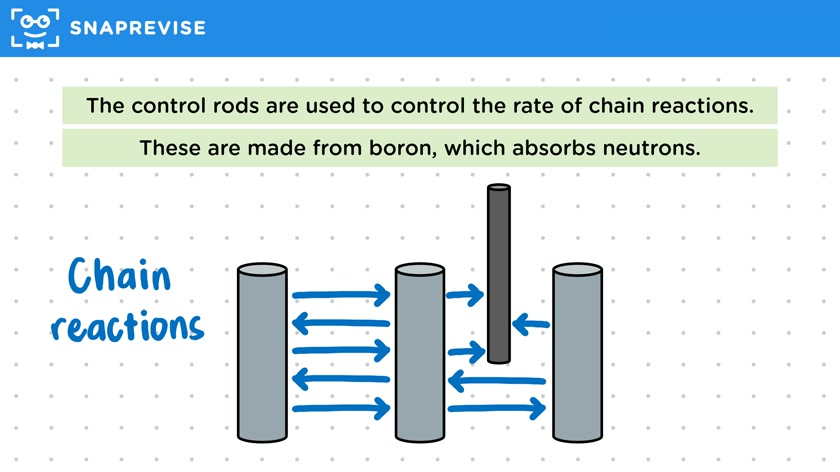
- Control rods control the rate of chain reactions and are different from fuel rods.
- Control rods, made from boron, absorb neutrons and can be moved in and out of the reactor.
- Control rods block neutron paths, limiting chain reactions.
- Limiting neutrons is important to prevent uncontrolled reactions.
- To slow reactions, more control rods are lowered or moved further down.
- More control rods mean fewer neutrons move between fuel rods, reducing chain reactions.
- In emergencies, rods are lowered completely to stop reactions.
- Lowering rods blocks paths between fuel rods, stopping neutrons and ending reactions.
- Safety features in fission reactors are crucial for design and operation.
Please subscribe to access these revision notes.
This, and all other video notes, are included in our premium subscriptions.
Premium accounts get access to all videos and revision notes.
137
questions for Atomic structure
71
questions for Atoms and nuclear radiation