
GCSE Physics (AQA)
346 videos | 23 hours
Please subscribe to watch this video.
This, and all other videos, are included in our premium subscriptions.
Premium accounts get access to all videos.
Enable autoplay to keep watching
Your browser is blocking videos from playing automatically. To turn it back on:
Safari (Mac): Click the Safari menu item in the top bar, then Settings → Websites → Auto-Play, then set Auto-Play to Allow All Auto-Play for the current website.
Safari (iPhone/iPad): open the Settings app, then Apps → Safari → Auto-Play, and select Allow All Auto-Play.
Orbital Speed
- The closer a planet or satellite is to the object it is orbiting, the stronger the gravitational force acting on it.
- A satellite or planet will orbit when gravitational forces keep them traveling in a circular path.
- Mercury, being closer to the sun, experiences a stronger gravitational force than Venus, which is further away.
- The stronger the gravitational force, the faster an object will move in its orbit.
- Mercury moves faster (48 km/s) than Venus (35 km/s) due to stronger gravitational forces.
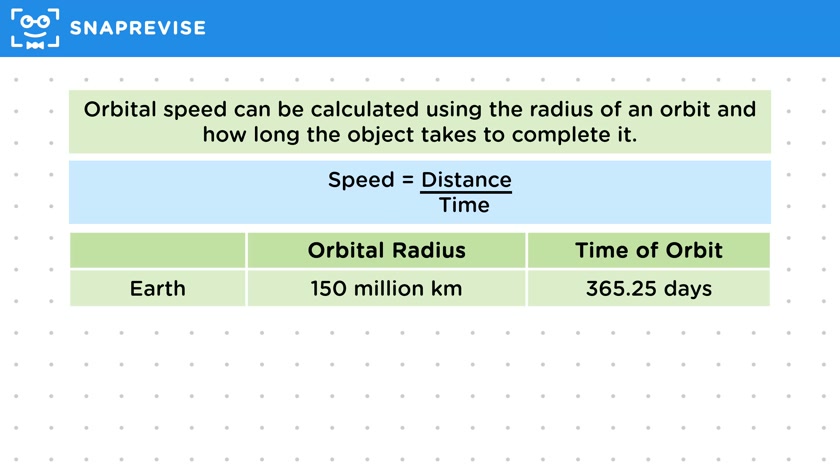
- Orbital speed can be calculated using the radius of an orbit and the time taken to complete it.
- Earth's orbit speed can be calculated using its orbital radius (150 million km) and time (365.25 days).
- Earth travels at 2.6 million km/day, or 30,000 m/s.
- The speed of planets varies; further planets from the sun move slower due to weaker gravitational forces.
- Understanding the relation between radius, force, and speed is important for choosing orbits of artificial satellites.
- Polar satellites move quickly in low orbits to cover much of Earth's surface.
- Geostationary satellites move slowly in far orbits to match Earth's rotation.
- The link between a satellite's orbit and its speed should be understood, though specific satellite types need not be recalled for exams.
Please subscribe to access these revision notes.
This, and all other video notes, are included in our premium subscriptions.
Premium accounts get access to all videos and revision notes.
61
questions for Space physics (physics only)
42
questions for Solar system; stability of orbital motions; satellites (physics only)