
GCSE Physics (AQA)
346 videos | 23 hours
Please subscribe to watch this video.
This, and all other videos, are included in our premium subscriptions.
Premium accounts get access to all videos.
Enable autoplay to keep watching
Your browser is blocking videos from playing automatically. To turn it back on:
Safari (Mac): Click the Safari menu item in the top bar, then Settings → Websites → Auto-Play, then set Auto-Play to Allow All Auto-Play for the current website.
Safari (iPhone/iPad): open the Settings app, then Apps → Safari → Auto-Play, and select Allow All Auto-Play.
Orbits & Circular Motion
- Planets and satellites travel in orbits due to gravity pulling them towards the center.
- Orbits are circular paths around the sun or planets.
- The moon is a natural satellite orbiting the earth.
- Velocity is a vector quantity indicating speed and direction.
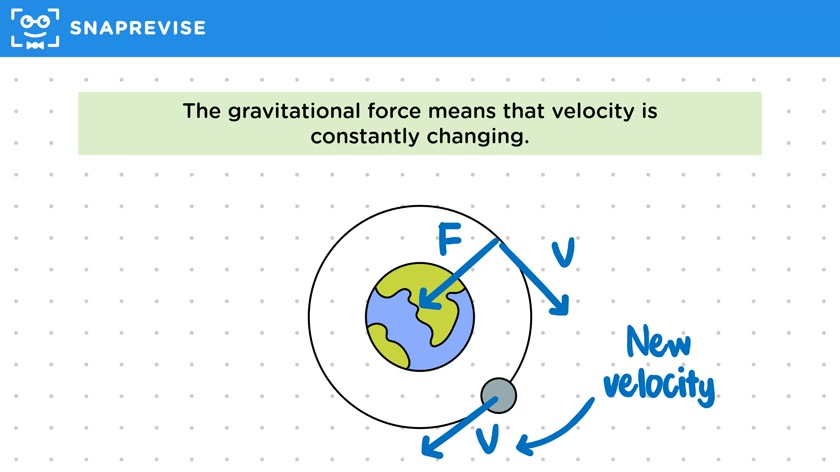
- Gravitational force causes the moon's velocity to constantly change.
- According to Newton's second law, a force causes an object to accelerate, changing its velocity.
- The gravitational force makes the moon accelerate, changing its direction of motion.
- The force always points towards the earth, changing direction as the moon moves.
- Velocity points in the direction of motion, while the force is perpendicular, pointing to the orbit's center.
- For circular orbits, only the direction of velocity changes, not the speed.
- Orbits are technically elliptical but treated as circular for simplicity.
- In circular motion, speed remains constant while velocity changes direction.
- The moon's velocity has the same magnitude but changes direction to maintain its circular path.
- Despite constant speed, velocity changes due to direction change.
- Understanding the relationship between orbits, circular motion, and gravity's effect on velocity is important for exams.
Please subscribe to access these revision notes.
This, and all other video notes, are included in our premium subscriptions.
Premium accounts get access to all videos and revision notes.
61
questions for Space physics (physics only)
42
questions for Solar system; stability of orbital motions; satellites (physics only)