
GCSE Physics (AQA)
346 videos | 23 hours
Please subscribe to watch this video.
This, and all other videos, are included in our premium subscriptions.
Premium accounts get access to all videos.
Enable autoplay to keep watching
Your browser is blocking videos from playing automatically. To turn it back on:
Safari (Mac): Click the Safari menu item in the top bar, then Settings → Websites → Auto-Play, then set Auto-Play to Allow All Auto-Play for the current website.
Safari (iPhone/iPad): open the Settings app, then Apps → Safari → Auto-Play, and select Allow All Auto-Play.
Planets, Dwarf Planets & Moons
- There are eight planets orbiting the sun in our solar system.
- The sun is a star that planets orbit due to its gravitational field.
- For exams, understanding the similarities and differences between planets is required, not naming them.
- The four closest planets to the sun are rocky (Mercury, Venus, Earth, Mars) and have solid surfaces.
- The four furthest planets from the sun are gas giants (Jupiter, Saturn, Uranus, Neptune) and are made up of gas, making them unsuitable for standing on.
- Gas planets are the largest in the solar system, though their sizes vary.
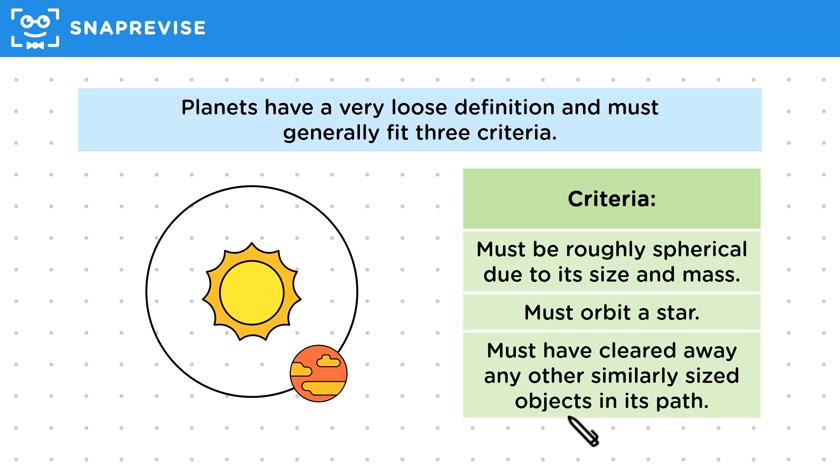
- Planets must meet three criteria: be roughly spherical, orbit a star, and have cleared their orbital path of similarly sized objects.
- Dwarf planets, like Pluto, orbit the sun and are nearly spherical but haven't cleared their orbital paths of debris, distinguishing them from regular planets.
- Moons are natural satellites that orbit planets or dwarf planets, with Earth having one moon.
- Planets orbit stars, while moons orbit planets, and planets can have multiple moons, e.g., Uranus has 27 moons.
- Specific numbers of moons for each planet are not required knowledge for exams.
Please subscribe to access these revision notes.
This, and all other video notes, are included in our premium subscriptions.
Premium accounts get access to all videos and revision notes.
61
questions for Space physics (physics only)
42
questions for Solar system; stability of orbital motions; satellites (physics only)