
GCSE Physics (AQA)
346 videos | 23 hours
Please subscribe to watch this video.
This, and all other videos, are included in our premium subscriptions.
Premium accounts get access to all videos.
Enable autoplay to keep watching
Your browser is blocking videos from playing automatically. To turn it back on:
Safari (Mac): Click the Safari menu item in the top bar, then Settings → Websites → Auto-Play, then set Auto-Play to Allow All Auto-Play for the current website.
Safari (iPhone/iPad): open the Settings app, then Apps → Safari → Auto-Play, and select Allow All Auto-Play.
Potential Difference from an Alternator
- The potential difference and current in an alternator change as it rotates.
- An alternator converts kinetic energy into electrical energy by inducing a potential difference.
- The coil in an alternator is rotated using a turbine or hand crank, causing it to spin in a magnetic field.
- This rotation causes the sides of the conductor to cut through magnetic field lines, inducing a potential difference and current in a connected circuit.
- The induced current is an alternating current (AC), where the potential difference and current periodically change direction.
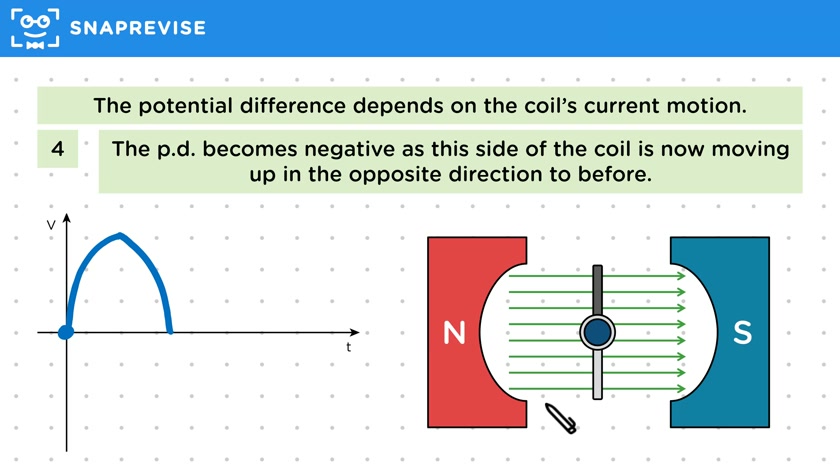
- The potential difference depends on the coil's motion and the speed at which it cuts the magnetic field lines.
- When the coil is vertical and moving parallel to the field lines, no potential difference is induced.
- As the coil moves down and cuts the field lines perpendicularly, the potential difference increases to a maximum.
- The potential difference then decreases back to zero as the coil returns to a vertical position.
- When the coil moves up in the opposite direction, the potential difference becomes negative due to the change in direction of motion.
- The alternator setup causes the direction of the current in the connected circuit to change accordingly.
- The potential difference can be increased by using more turns in the coil, wrapping the coil around an iron core, using stronger magnets, or rotating the coil faster.
- Rotating the coil faster increases both the maximum potential difference and the frequency of the alternating potential difference.
- The frequency of the alternating potential difference refers to how often its pattern repeats on a graph.
- Rotating the coil faster results in higher peaks and less time between the peaks on the graph, indicating a higher frequency of alternation.
Please subscribe to access these revision notes.
This, and all other video notes, are included in our premium subscriptions.
Premium accounts get access to all videos and revision notes.
99
questions for Magnetism and electromagnetism
38
questions for Induced potential, transformers and the National Grid (physics only) (HT only)