
GCSE Physics (AQA)
346 videos | 23 hours
Please subscribe to watch this video.
This, and all other videos, are included in our premium subscriptions.
Premium accounts get access to all videos.
Enable autoplay to keep watching
Your browser is blocking videos from playing automatically. To turn it back on:
Safari (Mac): Click the Safari menu item in the top bar, then Settings → Websites → Auto-Play, then set Auto-Play to Allow All Auto-Play for the current website.
Safari (iPhone/iPad): open the Settings app, then Apps → Safari → Auto-Play, and select Allow All Auto-Play.
Radio Wave Signals
- Radio waves are used to send signals between aerials.
- The process involves alternating current causing electrons to move in the transmitting aerial.
- Alternating current (AC) transfers electrical energy by moving delocalized electrons in a conductor.
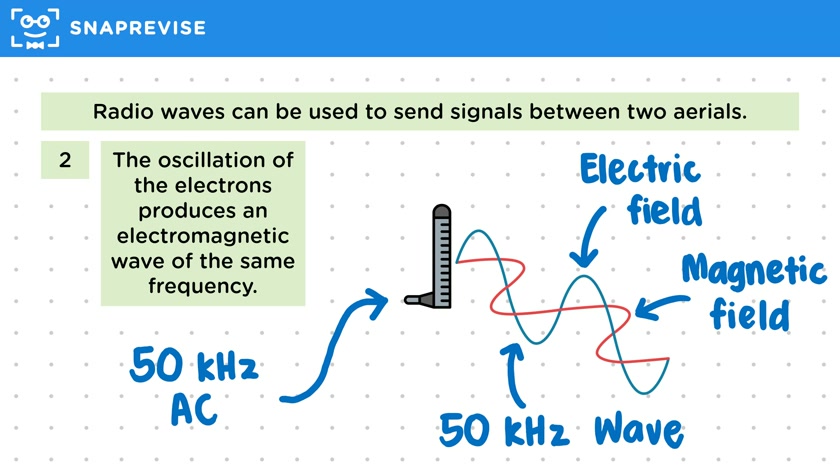
- The oscillation of electrons produces an electromagnetic wave of the same frequency.
- Electromagnetic waves are transverse waves that travel as oscillations between electric and magnetic fields.
- The frequency of the electromagnetic wave matches the frequency of the current.
- Radio waves are produced because they have the lowest frequency among electromagnetic waves.
- The electromagnetic wave travels to a receiving aerial, which should be aligned with the transmitting aerial.
- The wave transfers energy from the transmitting aerial to the receiving aerial.
- The wave causes electrons in the receiving aerial to oscillate with the same frequency.
- This oscillation produces an alternating current in the receiving aerial, carrying energy and information.
- The frequency of the receiving current is determined by the frequency of the wave.
- Signals are sent by varying frequencies and amplitudes in the waves.
- Computers and speakers can translate these signals into messages.
Please subscribe to access these revision notes.
This, and all other video notes, are included in our premium subscriptions.
Premium accounts get access to all videos and revision notes.
172
questions for Waves
81
questions for Electromagnetic waves