
GCSE Physics (AQA)
346 videos | 23 hours
Please subscribe to watch this video.
This, and all other videos, are included in our premium subscriptions.
Premium accounts get access to all videos.
Enable autoplay to keep watching
Your browser is blocking videos from playing automatically. To turn it back on:
Safari (Mac): Click the Safari menu item in the top bar, then Settings → Websites → Auto-Play, then set Auto-Play to Allow All Auto-Play for the current website.
Safari (iPhone/iPad): open the Settings app, then Apps → Safari → Auto-Play, and select Allow All Auto-Play.
Red Giants & Supergiants
- All stars form from gas and dust in space, brought together by gravity, forming a dense and hot protostar.
- Stars remain in the main sequence stage as they fuse hydrogen in their cores.
- When hydrogen in the core is depleted, stars leave the main sequence.
- Hydrogen fusion changes to helium, and when hydrogen is exhausted, helium fusion begins.
- Low mass stars (like the sun) become red giants, swelling and increasing in brightness.
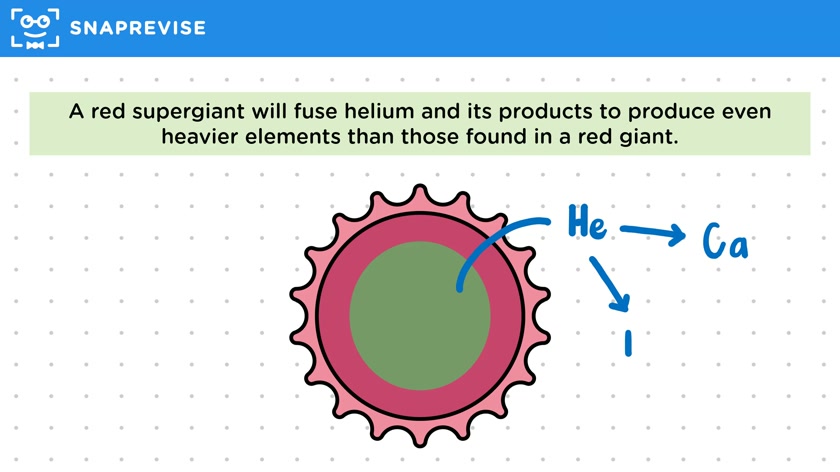
- High mass stars become red supergiants, which are much larger and undergo fusion to create elements heavier than helium, up to iron.
- The core of a red supergiant is hotter than that of a red giant, allowing for the fusion of heavier elements.
- Both red giants and red supergiants expand due to the energy released from fusion reactions.
- The stability of giants and supergiants is maintained by the balance between outward pressure from fusion and inward gravitational pull.
- Once fusion stops (red giants when helium is depleted, supergiants when elements up to iron are formed), the stars collapse.
- Red giants eventually become white dwarfs, while red supergiants may end in a supernova, leading to the creation of elements heavier than iron.
- Understanding the differences between red giants and red supergiants, including their origins and fusion processes, is crucial for related exams.
Please subscribe to access these revision notes.
This, and all other video notes, are included in our premium subscriptions.
Premium accounts get access to all videos and revision notes.
61
questions for Space physics (physics only)
42
questions for Solar system; stability of orbital motions; satellites (physics only)