
GCSE Physics (AQA)
346 videos | 23 hours
Please subscribe to watch this video.
This, and all other videos, are included in our premium subscriptions.
Premium accounts get access to all videos.
Enable autoplay to keep watching
Your browser is blocking videos from playing automatically. To turn it back on:
Safari (Mac): Click the Safari menu item in the top bar, then Settings → Websites → Auto-Play, then set Auto-Play to Allow All Auto-Play for the current website.
Safari (iPhone/iPad): open the Settings app, then Apps → Safari → Auto-Play, and select Allow All Auto-Play.
Red-Shift
- Stars absorb specific wavelengths of light they emit.
- Stars generate energy through nuclear reactions, emitting electromagnetic waves.
- Wavelengths determine wave properties, such as visible light color.
- Most waves are released into space, but some are absorbed by atoms in the star.
- Missing wavelengths appear as gaps in a light spectrum.
- A spectrum can be produced by refracting white light or analyzed with a computer.
- Emission spectrum shows different colors from low wavelength violet to high wavelength red.
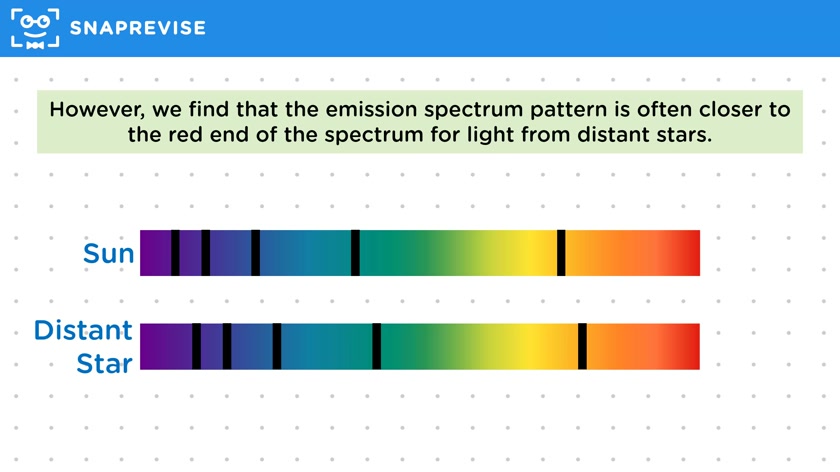
- Black bars in the spectrum indicate missing wavelengths absorbed by atoms.
- Astronomers use missing wavelength patterns to determine properties of distant stars.
- Each atom has a unique absorption pattern, e.g., hydrogen absorbs specific wavelengths.
- Emission spectra help identify elements in stars.
- Stars similar to the sun produce similar emission spectra.
- Emission spectrum patterns can shift towards the red end for distant stars, known as redshift.
- Redshift indicates light from distant galaxies increases in wavelength.
- The further the galaxy, the greater the redshift effect.
- Patterns can also shift towards the blue end, known as blueshift, indicating decreased wavelengths.
- Blueshift is less common and occurs in certain galaxies like Andromeda.
- Understanding redshift and blueshift helps analyze light from distant stars and galaxies.
Please subscribe to access these revision notes.
This, and all other video notes, are included in our premium subscriptions.
Premium accounts get access to all videos and revision notes.
61
questions for Space physics (physics only)
19
questions for Red-shift (physics only)