
GCSE Physics (AQA)
346 videos | 23 hours
Please subscribe to watch this video.
This, and all other videos, are included in our premium subscriptions.
Premium accounts get access to all videos.
Enable autoplay to keep watching
Your browser is blocking videos from playing automatically. To turn it back on:
Safari (Mac): Click the Safari menu item in the top bar, then Settings → Websites → Auto-Play, then set Auto-Play to Allow All Auto-Play for the current website.
Safari (iPhone/iPad): open the Settings app, then Apps → Safari → Auto-Play, and select Allow All Auto-Play.
Refraction Ray Diagrams
- Refraction of light can be demonstrated using a rectangular block of glass.
- Refraction occurs when a wave changes direction as it transmits from one medium to another.
- A ray of light directed into a glass block will change its path due to refraction.
- The ray emerges from the glass at a different point than expected if it traveled in a straight line.
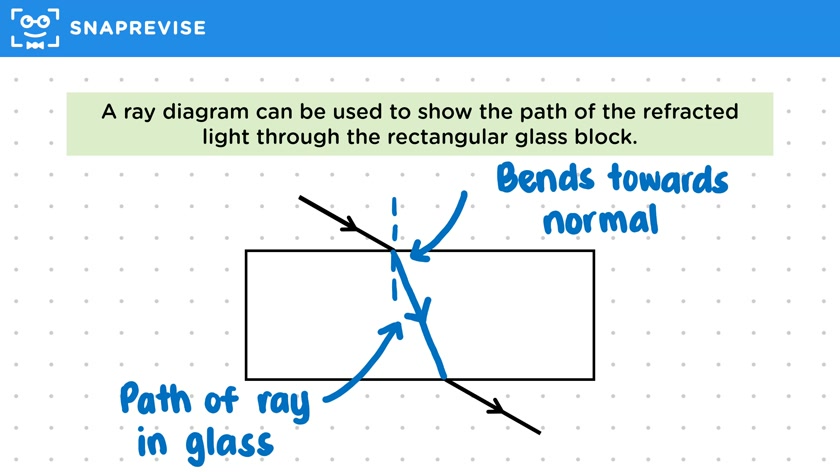
- A ray diagram can illustrate the path of refracted light through the glass block.
- Ray diagrams use straight lines and arrows to show the direction of light rays.
- The path of the ray inside the glass can be shown by joining the entry and exit points with a straight line.
- The normal line, perpendicular to the boundary, helps understand how the path changes.
- The ray bends towards the normal when entering the glass and away from the normal when exiting.
- For exams, students need to construct and analyze ray diagrams showing refraction.
- The direction of light changes can be described using the angle between the ray and the normal.
- The angle of incidence is the angle at which light enters the boundary.
- The angle of refraction is the angle at which light leaves the boundary.
- If the ray bends towards the normal, the angle of refraction is smaller than the angle of incidence.
- If the ray bends away from the normal, the angle of refraction is larger.
- The letter 'I' represents the angle of incidence, and 'R' represents the angle of refraction.
- GCSE students should identify and label these angles on a diagram but are not expected to calculate them.
Please subscribe to access these revision notes.
This, and all other video notes, are included in our premium subscriptions.
Premium accounts get access to all videos and revision notes.
172
questions for Waves
81
questions for Electromagnetic waves