
GCSE Physics (AQA)
346 videos | 23 hours
Please subscribe to watch this video.
This, and all other videos, are included in our premium subscriptions.
Premium accounts get access to all videos.
Enable autoplay to keep watching
Your browser is blocking videos from playing automatically. To turn it back on:
Safari (Mac): Click the Safari menu item in the top bar, then Settings → Websites → Auto-Play, then set Auto-Play to Allow All Auto-Play for the current website.
Safari (iPhone/iPad): open the Settings app, then Apps → Safari → Auto-Play, and select Allow All Auto-Play.
Seismic Waves
- Seismic waves are produced by earthquakes and travel through the earth.
- Seismic refers to anything related to earthquakes or vibrations in the earth.
- Earthquakes are caused by shifts in tectonic plates, resulting in tremors that damage buildings and the ground.
- Seismic waves carry large amounts of kinetic energy, causing buildings and the ground to shake and potentially be damaged.
- There are two types of seismic waves produced in an earthquake: P waves and S waves.
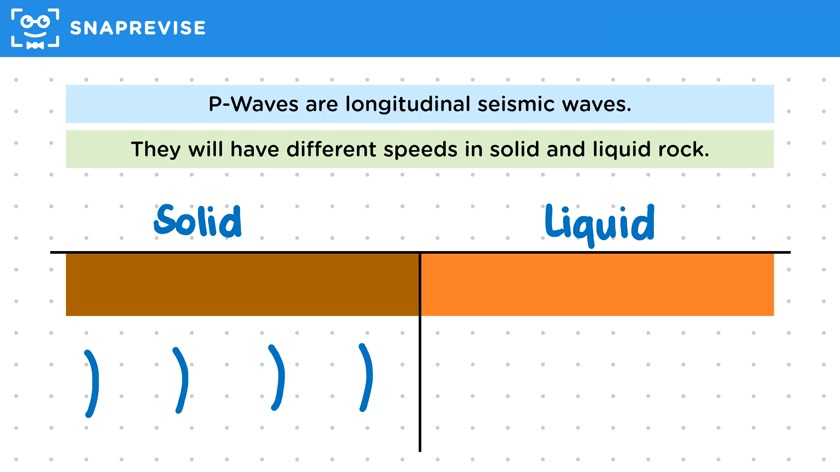
- P waves (primary waves) are longitudinal seismic waves that usually reach us first.
- P waves have different speeds in solid and liquid rock and slow down when crossing from solid to liquid.
- S waves (secondary waves) are transverse seismic waves that reach us after P waves.
- S waves cannot travel through liquids and are either absorbed or reflected at the boundary between solid and liquid rock.
- It is important to differentiate between P waves and S waves and identify them correctly.
Please subscribe to access these revision notes.
This, and all other video notes, are included in our premium subscriptions.
Premium accounts get access to all videos and revision notes.
172
questions for Waves
72
questions for Waves in air, fluids and solids