
GCSE Physics (AQA)
346 videos | 23 hours
Please subscribe to watch this video.
This, and all other videos, are included in our premium subscriptions.
Premium accounts get access to all videos.
Enable autoplay to keep watching
Your browser is blocking videos from playing automatically. To turn it back on:
Safari (Mac): Click the Safari menu item in the top bar, then Settings → Websites → Auto-Play, then set Auto-Play to Allow All Auto-Play for the current website.
Safari (iPhone/iPad): open the Settings app, then Apps → Safari → Auto-Play, and select Allow All Auto-Play.
Simple Resultant Force Calculations
- When two forces act in the same direction, the resultant force is in the same direction.
- Example: Two people pushing the same box results in a force to the right.
- The magnitude of the resultant force is the sum of the individual forces (fa + fb).
- Example: A ball pushed by a 5 Newton force and pulled by a 3 Newton force results in an 8 Newton force to the right.
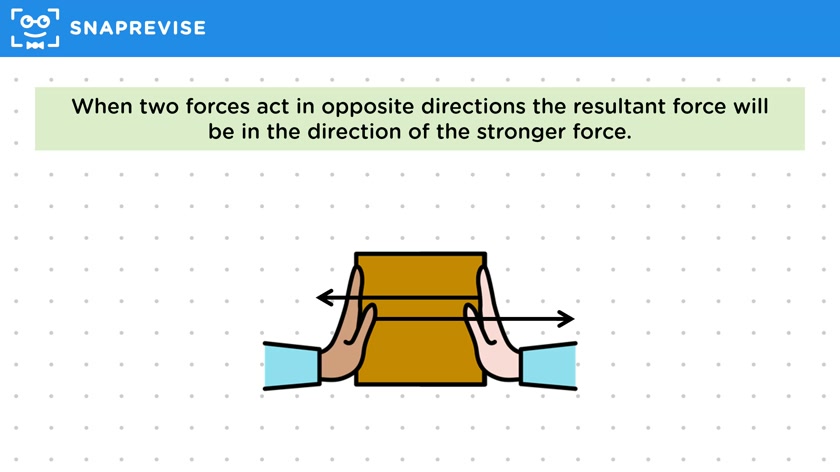
- When forces act in opposite directions, the resultant force is in the direction of the stronger force.
- Example: Two people pushing a box in opposite directions results in a force in the direction of the larger force.
- The magnitude of the resultant force is the difference between the individual forces (FA - fb).
- If forces are equal in opposite directions, the resultant force is zero, resulting in no motion.
- GCSE students are not expected to find resultant forces not aligned with given forces.
- Example: A parachutist with a 650 Newton downward force and an 800 Newton upward force results in a 150 Newton upward force, slowing the parachutist down.
Please subscribe to access these revision notes.
This, and all other video notes, are included in our premium subscriptions.
Premium accounts get access to all videos and revision notes.
321
questions for Forces
58
questions for Forces and their interactions