
GCSE Physics (AQA)
346 videos | 23 hours
Please subscribe to watch this video.
This, and all other videos, are included in our premium subscriptions.
Premium accounts get access to all videos.
Enable autoplay to keep watching
Your browser is blocking videos from playing automatically. To turn it back on:
Safari (Mac): Click the Safari menu item in the top bar, then Settings → Websites → Auto-Play, then set Auto-Play to Allow All Auto-Play for the current website.
Safari (iPhone/iPad): open the Settings app, then Apps → Safari → Auto-Play, and select Allow All Auto-Play.
Sonar
- Sonar is a detection system using ultrasound waves for scanning below the ocean surface.
- Sonar devices on ships detect underwater objects, represented as dots on a display indicating direction and depth.
- Some sonar devices generate full maps instead of detecting individual objects.
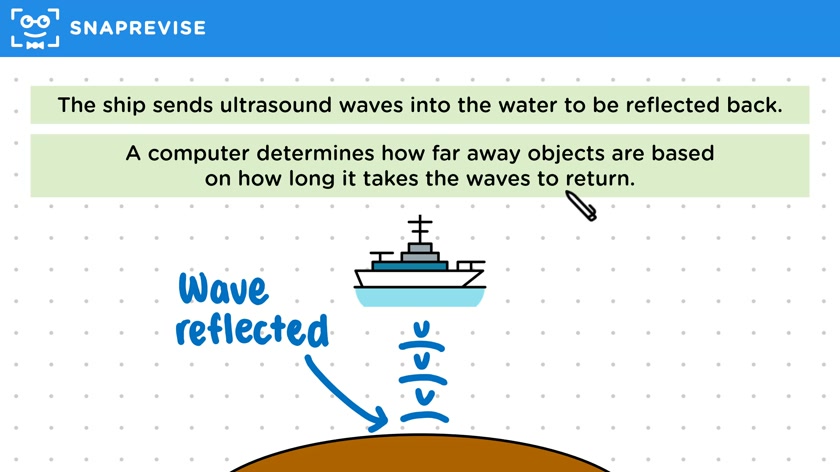
- Sonar works by sending ultrasound waves into the water, which reflect back upon reaching the seabed.
- A computer calculates the distance of objects by timing the return of the waves.
- Multiple beams in different directions help map the seabed by measuring various depths.
- Sonar is used for mapping seabeds, planning shipping routes, naval reconnaissance, detecting submarines, and tracking schools of fish.
- Marine biologists use sonar to track and study whales and other large aquatic animals.
- Understanding the sonar process is important for exams, though recalling specific uses is not necessary.
Please subscribe to access these revision notes.
This, and all other video notes, are included in our premium subscriptions.
Premium accounts get access to all videos and revision notes.
172
questions for Waves
72
questions for Waves in air, fluids and solids