
GCSE Physics (AQA)
346 videos | 23 hours
Please subscribe to watch this video.
This, and all other videos, are included in our premium subscriptions.
Premium accounts get access to all videos.
Enable autoplay to keep watching
Your browser is blocking videos from playing automatically. To turn it back on:
Safari (Mac): Click the Safari menu item in the top bar, then Settings → Websites → Auto-Play, then set Auto-Play to Allow All Auto-Play for the current website.
Safari (iPhone/iPad): open the Settings app, then Apps → Safari → Auto-Play, and select Allow All Auto-Play.
Sound Waves
- Sound waves are longitudinal waves that travel through matter.
- Sound waves cause air molecules to vibrate, transferring energy forward without moving the air.
- Sound is a mechanical wave and requires matter to travel through, which is why it doesn't travel in a vacuum like outer space.
- Sound can travel through solids, liquids, and gases, and can be transferred from one medium to another.
- Sound waves can be reflected or absorbed at boundaries.
- Example: A tuning fork vibrates, transferring sound from the solid fork to the gaseous air, allowing us to hear it.
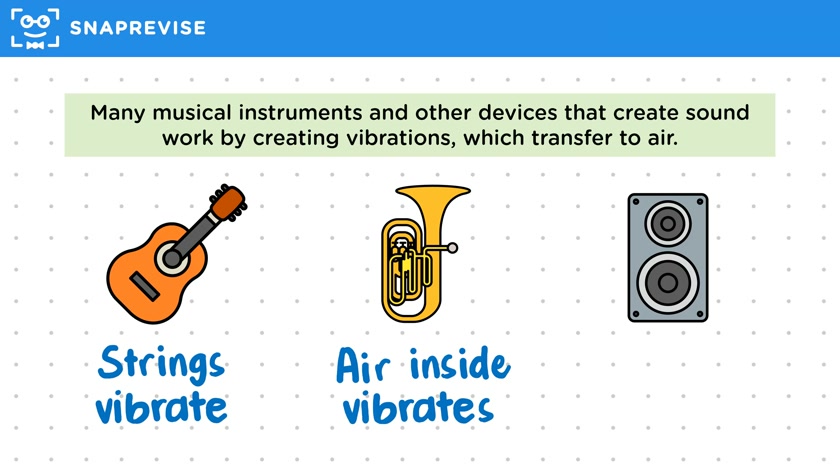
- Musical instruments create sound by transferring vibrations to air (e.g., guitar strings, trumpets).
- Speakers convert electrical signals into sound waves by vibrating diaphragms.
- The amplitude of sound waves determines the volume; larger amplitude means louder sound.
- The frequency of sound waves determines the pitch; higher frequency means higher pitch.
- Pitch changes with the speed of a recording due to frequency changes.
- Understanding wave properties is important for explaining how sound is heard from devices.
Please subscribe to access these revision notes.
This, and all other video notes, are included in our premium subscriptions.
Premium accounts get access to all videos and revision notes.
172
questions for Waves
72
questions for Waves in air, fluids and solids