
GCSE Physics (AQA)
346 videos | 23 hours
Please subscribe to watch this video.
This, and all other videos, are included in our premium subscriptions.
Premium accounts get access to all videos.
Enable autoplay to keep watching
Your browser is blocking videos from playing automatically. To turn it back on:
Safari (Mac): Click the Safari menu item in the top bar, then Settings → Websites → Auto-Play, then set Auto-Play to Allow All Auto-Play for the current website.
Safari (iPhone/iPad): open the Settings app, then Apps → Safari → Auto-Play, and select Allow All Auto-Play.
Supernova
- A large main sequence star fuses hydrogen into helium.
- This fusion releases energy as heat and light, counteracting gravity.
- When hydrogen runs out, the star becomes a red super giant, fusing heavier nuclei until an iron core forms.
- Only stars much larger than the sun become super giants; smaller stars follow different life stages.
- In the super giant state, the star is hotter, allowing more fusion reactions.
- It's difficult to fuse iron or heavier elements, so the core eventually consists only of iron.
- As the red super giant cools and collapses, gravity compresses the core.
- The immense pressure allows some iron to fuse into heavier nuclei, like gold.
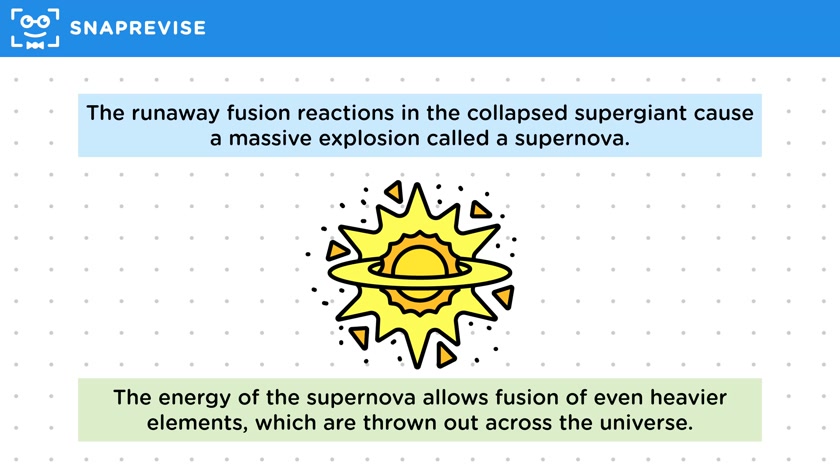
- Runaway fusion reactions in the collapsed super giant lead to a supernova explosion.
- The supernova releases a huge amount of energy, causing further fusion reactions.
- The explosion allows fusion of even heavier elements, which are dispersed across the universe.
- Heavy elements like lead, radon, uranium, and rubidium are formed during this explosion.
- These elements have useful applications, e.g., lead in piping and batteries, uranium in nuclear reactors.
- Understanding the life of a star explains the origin of these atoms.
- All heavy elements on earth and in the universe were once hydrogen atoms in a star.
- Life stages of a star: high mass star forms from dust, becomes a main sequence star, enlarges to a red super giant, collapses, and explodes as a supernova.
- Hydrogen atoms fuse into heavier elements during these stages.
- Main sequence stars fuse hydrogen into helium; red super giants fuse up to iron.
- Supernovae are responsible for forming the heaviest atoms like uranium.
- Supernovae glow extremely bright and can outshine entire galaxies for weeks.
- Supernova shockwaves are larger and brighter than surrounding galaxies, making them easier to detect than main sequence or giant stars.
Please subscribe to access these revision notes.
This, and all other video notes, are included in our premium subscriptions.
Premium accounts get access to all videos and revision notes.
61
questions for Space physics (physics only)
42
questions for Solar system; stability of orbital motions; satellites (physics only)