
GCSE Physics (AQA)
346 videos | 23 hours
Please subscribe to watch this video.
This, and all other videos, are included in our premium subscriptions.
Premium accounts get access to all videos.
Enable autoplay to keep watching
Your browser is blocking videos from playing automatically. To turn it back on:
Safari (Mac): Click the Safari menu item in the top bar, then Settings → Websites → Auto-Play, then set Auto-Play to Allow All Auto-Play for the current website.
Safari (iPhone/iPad): open the Settings app, then Apps → Safari → Auto-Play, and select Allow All Auto-Play.
Temperature & Clouds
- Clouds partially reflect infrared radiation.
- Infrared waves can reflect, transmit, or be absorbed when reaching a boundary.
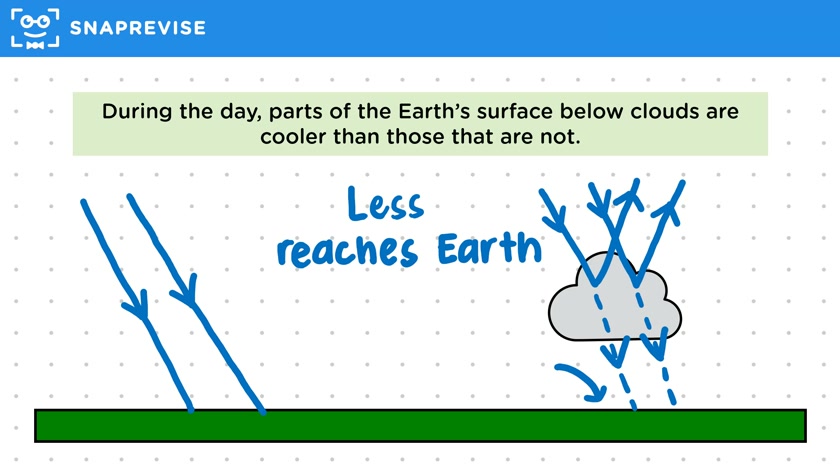
- Infrared waves from the sun interact with clouds before reaching Earth's surface.
- On cloudy days, some energy is reflected back into space, and some transmits through clouds to Earth.
- During the day, areas under clouds are cooler than those not under clouds.
- Clouds partially reflect infrared waves, reducing energy reaching Earth's surface.
- At night, areas under clouds are warmer than those not under clouds.
- Earth releases heat as waves, gaining and losing heat during the day, and only losing heat at night.
- Without clouds, waves escape into space; with clouds, waves partially transmit and reflect back to Earth.
- Reflected heat from clouds keeps areas under them warmer at night.
- Understanding infrared radiation and cloud effects is important for explaining temperature variations on Earth.
Please subscribe to access these revision notes.
This, and all other video notes, are included in our premium subscriptions.
Premium accounts get access to all videos and revision notes.
172
questions for Waves
19
questions for Black body radiation (physics only)