
GCSE Physics (AQA)
346 videos | 23 hours
Please subscribe to watch this video.
This, and all other videos, are included in our premium subscriptions.
Premium accounts get access to all videos.
Enable autoplay to keep watching
Your browser is blocking videos from playing automatically. To turn it back on:
Safari (Mac): Click the Safari menu item in the top bar, then Settings → Websites → Auto-Play, then set Auto-Play to Allow All Auto-Play for the current website.
Safari (iPhone/iPad): open the Settings app, then Apps → Safari → Auto-Play, and select Allow All Auto-Play.
Terminal Velocity
- Terminal velocity is the constant downward velocity an object reaches when falling in a fluid.
- Fluids include liquids and gases where particles can flow and move.
- Objects moving through fluids experience drag or air resistance forces.
- Example: A coin falling through air.
- Initially, the coin accelerates downward due to its weight, a force caused by Earth's gravity.
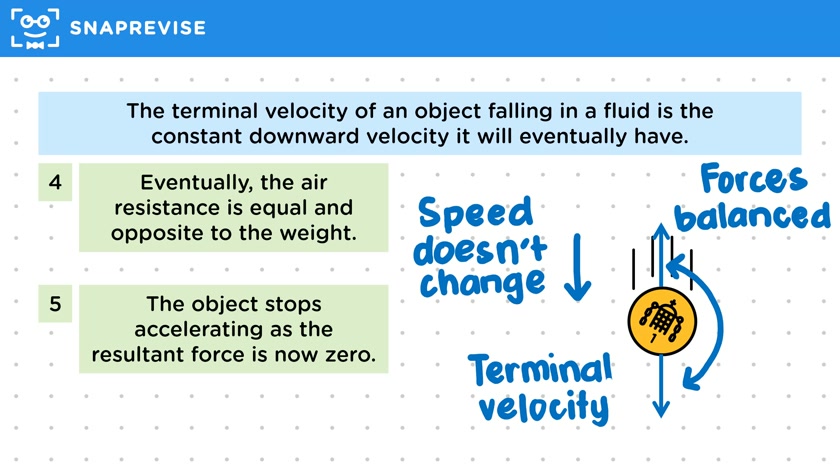
- Air resistance opposes the weight and increases as the object's speed increases.
- The coin continues to accelerate until air resistance equals the weight, resulting in balanced forces.
- When forces are balanced, the object stops accelerating and maintains a constant speed, known as terminal velocity.
- Terminal velocities can be reached in any fluid, including liquids.
- In liquids, drag forces replace air resistance and depend on the object's speed.
- Objects reach terminal velocity faster in thicker fluids due to stronger drag forces.
- Viscosity is the measure of a fluid's thickness and affects drag forces.
- Example: A coin in water vs. honey shows that thicker fluids like honey result in smaller terminal velocities reached in less time.
- Liquid-liquid comparisons are common, with thicker liquids causing objects to reach terminal velocity sooner.
Please subscribe to access these revision notes.
This, and all other video notes, are included in our premium subscriptions.
Premium accounts get access to all videos and revision notes.
153
questions for Forces
98
questions for Forces and motion