
GCSE Physics (AQA)
346 videos | 23 hours
Please subscribe to watch this video.
This, and all other videos, are included in our premium subscriptions.
Premium accounts get access to all videos.
Enable autoplay to keep watching
Your browser is blocking videos from playing automatically. To turn it back on:
Safari (Mac): Click the Safari menu item in the top bar, then Settings → Websites → Auto-Play, then set Auto-Play to Allow All Auto-Play for the current website.
Safari (iPhone/iPad): open the Settings app, then Apps → Safari → Auto-Play, and select Allow All Auto-Play.
The Atmosphere
- The atmosphere is a thin layer of air around the Earth's surface.
- Air is a mix of nitrogen, oxygen, and other gases.
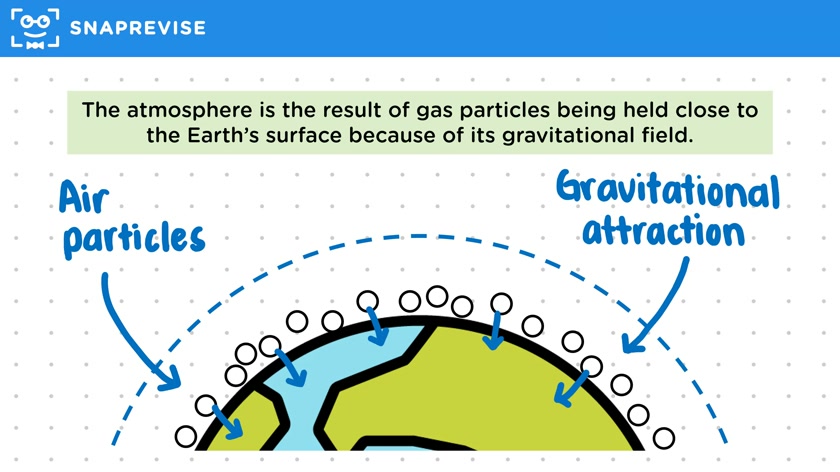
- The atmosphere is the result of gas particles being held close to the Earth's surface by its gravitational field.
- A gravitational field is generated by an object's mass, pulling other mass to the center.
- There is a large concentration of air particles close to the Earth's surface due to gravity.
- Other planets don't have the right conditions to maintain an atmosphere, so air escapes or is absorbed.
- Air particles are less concentrated further from the Earth where the gravitational field is weaker.
- A gravitational field becomes weaker the further we are from the center, resulting in fewer air particles.
- There is less air further from the center as gravity is weaker, making it harder to keep air in the atmosphere.
- It becomes harder to breathe when climbing mountains due to less concentrated air particles.
- Climbers may need an air supply at high altitudes.
- For exams, it's important to explain the Earth's atmosphere and how air molecule density changes with height.
Please subscribe to access these revision notes.
This, and all other video notes, are included in our premium subscriptions.
Premium accounts get access to all videos and revision notes.
153
questions for Forces
19
questions for Pressure and pressure differences in fluids (physics only)