
GCSE Physics (AQA)
346 videos | 23 hours
Please subscribe to watch this video.
This, and all other videos, are included in our premium subscriptions.
Premium accounts get access to all videos.
Enable autoplay to keep watching
Your browser is blocking videos from playing automatically. To turn it back on:
Safari (Mac): Click the Safari menu item in the top bar, then Settings → Websites → Auto-Play, then set Auto-Play to Allow All Auto-Play for the current website.
Safari (iPhone/iPad): open the Settings app, then Apps → Safari → Auto-Play, and select Allow All Auto-Play.
The Big Bang Theory
- The Big Bang Theory is the leading theory for the origin of the universe.
- The universe began from a very small, hot, and dense region, treated as a single point.
- This point contained all the matter that would make up the universe, resulting in a massive buildup of heat.
- A massive explosion, the Big Bang, caused the matter to expand away from the universe's origin point.
- The universe was initially hot, with matter not in a solid, liquid, or gaseous state.
- Over time, the hot matter cooled into atoms of gas and dust, forming stars and galaxies.
- Atoms came together to form planets, moons, and other large bodies, pulled together by gravity to form galaxies.
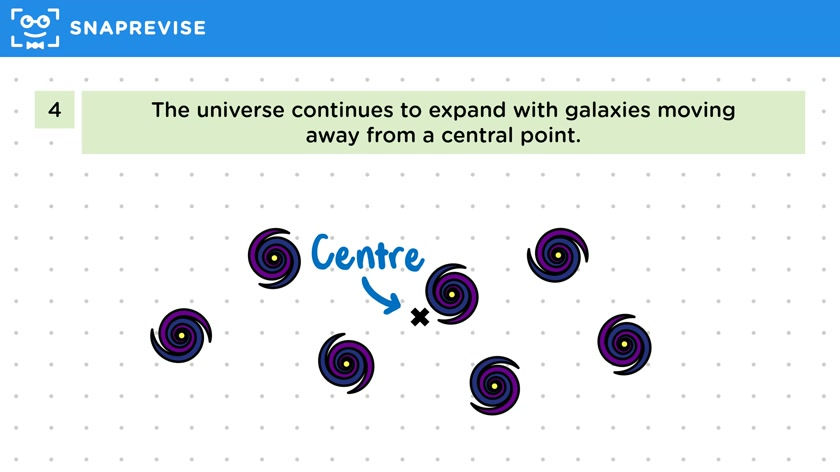
- The universe continues to expand, with galaxies moving away from a central point.
- The size of the universe is interpreted based on the distance of matter from the Big Bang's origin point.
- Galaxies move outwards from the central point, indicating the universe's expansion.
- The further a galaxy is from the center, the faster it is moving.
- From Earth's perspective, it appears that all galaxies are moving away from us.
- The motion of galaxies suggests they are spreading out, consistent with the Big Bang theory.
- The perspective from Earth makes it seem like galaxies are moving in opposite directions to get further away from us.
Please subscribe to access these revision notes.
This, and all other video notes, are included in our premium subscriptions.
Premium accounts get access to all videos and revision notes.
61
questions for Space physics (physics only)
19
questions for Red-shift (physics only)