
GCSE Physics (AQA)
346 videos | 23 hours
Please subscribe to watch this video.
This, and all other videos, are included in our premium subscriptions.
Premium accounts get access to all videos.
Enable autoplay to keep watching
Your browser is blocking videos from playing automatically. To turn it back on:
Safari (Mac): Click the Safari menu item in the top bar, then Settings → Websites → Auto-Play, then set Auto-Play to Allow All Auto-Play for the current website.
Safari (iPhone/iPad): open the Settings app, then Apps → Safari → Auto-Play, and select Allow All Auto-Play.
The Generator Effect
- A conductor moving through a magnetic field can induce a current if part of a circuit.
- A potential difference is induced across a conductor when it cuts through magnetic field lines.
- This potential difference can generate an electric current if the conductor is part of a complete circuit.
- Connecting the conductor to an ammeter can detect the presence of current.
- A complete circuit is formed when the conductor is connected to the ammeter.
- The ammeter needle twitches when the conductor passes through the magnetic field, indicating current flow.
- This phenomenon is known as the generator effect, a key application of magnetic fields.
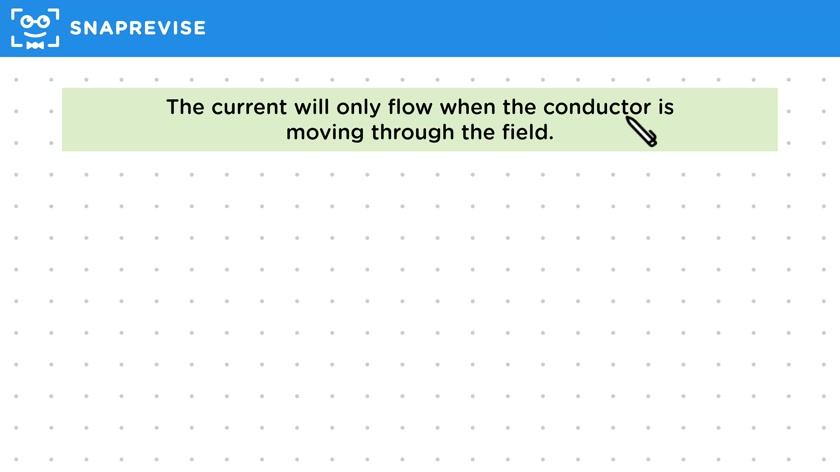
- Current only flows when the conductor is moving through the field.
- Moving the conductor up and down causes periodic movement of the ammeter needle and changes in current direction.
- The generator effect can also be demonstrated by passing a magnet through a coil of wire in a circuit.
- Coils of wire can produce stronger currents from the generator effect.
- Connecting the coil to an ammeter forms a complete circuit.
- Moving a bar magnet into the coil induces a current, as shown by the ammeter needle twitching.
- Induced potential differences and currents depend on relative motion between a conductor and a magnetic field.
- Continuous movement of the magnet is required to maintain current flow.
Please subscribe to access these revision notes.
This, and all other video notes, are included in our premium subscriptions.
Premium accounts get access to all videos and revision notes.
99
questions for Magnetism and electromagnetism
38
questions for Induced potential, transformers and the National Grid (physics only) (HT only)