
GCSE Physics (AQA)
346 videos | 23 hours
Please subscribe to watch this video.
This, and all other videos, are included in our premium subscriptions.
Premium accounts get access to all videos.
Enable autoplay to keep watching
Your browser is blocking videos from playing automatically. To turn it back on:
Safari (Mac): Click the Safari menu item in the top bar, then Settings → Websites → Auto-Play, then set Auto-Play to Allow All Auto-Play for the current website.
Safari (iPhone/iPad): open the Settings app, then Apps → Safari → Auto-Play, and select Allow All Auto-Play.
Thermistors
- Thermistor resistance decreases as temperature increases.
- Most components increase resistance with temperature, but thermistors decrease.
- Thermistors contain special material that releases more charge carriers with temperature changes.
- GCSE students need to know the circuit symbol for a thermistor, resembling a resistor with a line through it.
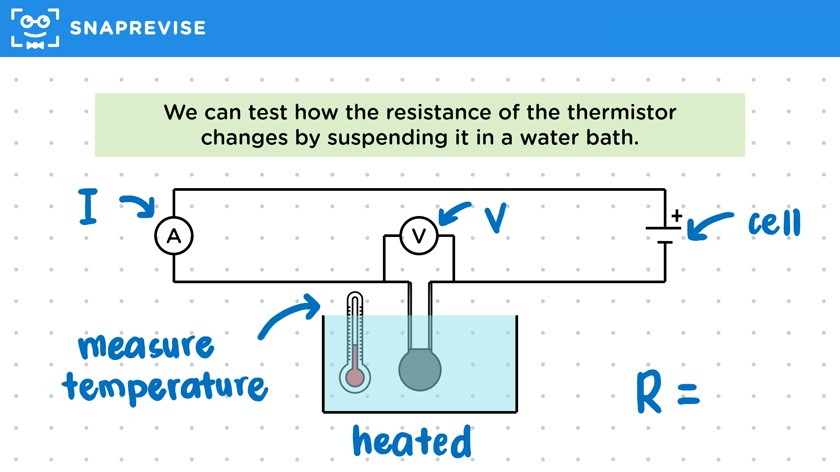
- Thermistor properties can be tested by suspending it in a heated water bath.
- The experiment setup includes a thermistor in a water bath, measuring temperature as the independent variable.
- A circuit with a cell, ammeter, and voltmeter measures current and potential difference.
- Resistance is calculated using R = V/I, with resistance as the dependent variable.
- Results are plotted on a graph with temperature on the horizontal axis and resistance on the vertical axis, showing a smooth curve.
- Low temperature results in high resistance; high temperature results in low resistance.
- Some thermostats increase resistance with temperature, but not required knowledge for GCSE.
- Thermistors are used in devices needing to react to temperature changes, like fire alarms and fridges.
- Fire alarms use thermistors to restrict current until high temperature triggers an alarm.
- Fridges use thermistors to adjust cooling power based on internal temperature.
- GCSE exams may require explaining thermistor use in devices, not recalling specific examples.
Please subscribe to access these revision notes.
This, and all other video notes, are included in our premium subscriptions.
Premium accounts get access to all videos and revision notes.
144
questions for Electricity
48
questions for Current, potential difference and resistance