
GCSE Physics (AQA)
346 videos | 23 hours
Please subscribe to watch this video.
This, and all other videos, are included in our premium subscriptions.
Premium accounts get access to all videos.
Enable autoplay to keep watching
Your browser is blocking videos from playing automatically. To turn it back on:
Safari (Mac): Click the Safari menu item in the top bar, then Settings → Websites → Auto-Play, then set Auto-Play to Allow All Auto-Play for the current website.
Safari (iPhone/iPad): open the Settings app, then Apps → Safari → Auto-Play, and select Allow All Auto-Play.
Three-Core Plugs
- Cables carry electrical currents from plug sockets to appliances.
- Cables are wrapped with insulating plastic to prevent electrocution.
- Inside a cable, there are three wires: live wire (brown), neutral wire (blue), and earth wire (green and yellow striped).
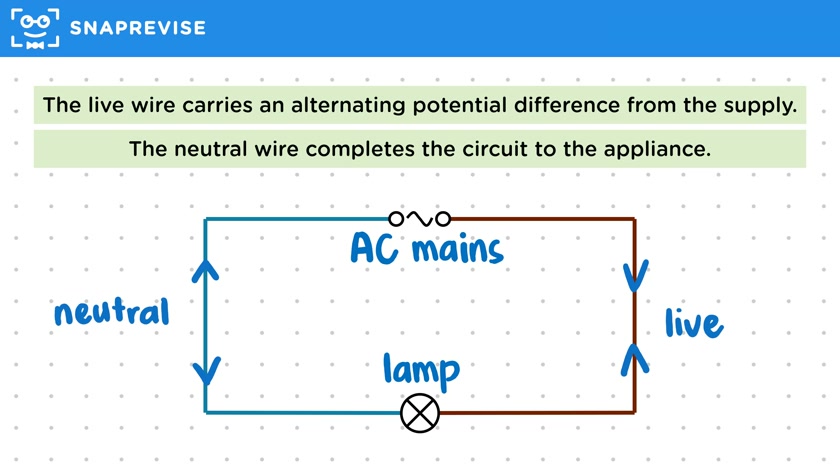
- Live wire carries an alternating potential difference from the supply.
- Neutral wire completes the circuit to the appliance, allowing current to flow.
- The current in both live and neutral wires constantly changes direction due to alternating current.
- Each wire in a cable corresponds to a prong in a plug.
- In British plugs, the neutral wire is on the left, the live wire on the right, and the earth wire at the top.
- The current from the live wire passes through a fuse before reaching its prong.
- Some plugs have only two prongs, with earth wires connecting to a separate conductor on their casing.
- A fuse breaks a circuit when the current becomes too large, containing a thin wire that melts at high currents.
- Fuses are used in plugs to cut off the live wire when its current becomes too large and can also be connected directly in circuits.
- The circuit symbol for a fuse looks like a resistor with a line through it.
Please subscribe to access these revision notes.
This, and all other video notes, are included in our premium subscriptions.
Premium accounts get access to all videos and revision notes.
144
questions for Electricity
20
questions for Domestic uses and safety