
GCSE Physics (AQA)
346 videos | 23 hours
Please subscribe to watch this video.
This, and all other videos, are included in our premium subscriptions.
Premium accounts get access to all videos.
Enable autoplay to keep watching
Your browser is blocking videos from playing automatically. To turn it back on:
Safari (Mac): Click the Safari menu item in the top bar, then Settings → Websites → Auto-Play, then set Auto-Play to Allow All Auto-Play for the current website.
Safari (iPhone/iPad): open the Settings app, then Apps → Safari → Auto-Play, and select Allow All Auto-Play.
Thunder Clouds
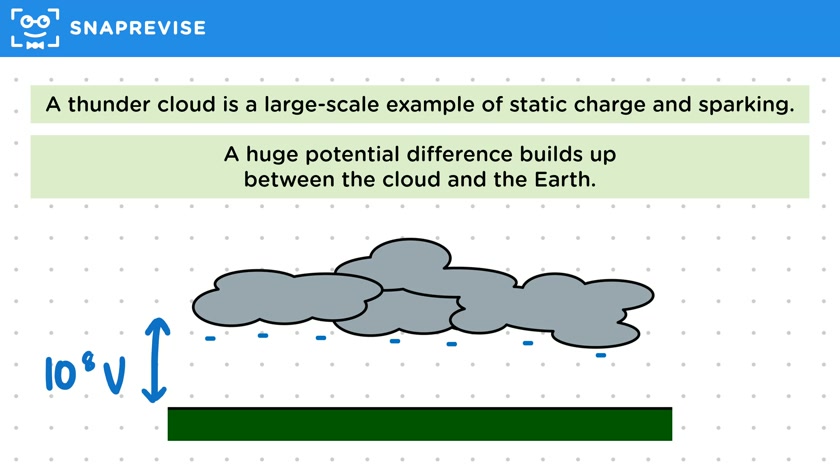
- Thunderclouds are large-scale examples of static charge and sparking.
- Thunderstorms occur with high heat, high pressure, and water evaporation.
- Warm air rises, cools, and condenses into water droplets.
- Ice crystals in clouds rub together, building up static charge.
- Ice crystals collide, forming smaller crystals and building electric charge.
- The cloud's bottom becomes negatively charged as heavy negative crystals fall and lighter positive crystals rise.
- A huge potential difference builds between the cloud and the earth due to the cloud's negative charge and the earth being uncharged.
- The potential difference can reach 10^8 volts, much higher than household electricity at 230 volts.
- The cloud discharges through a lightning bolt, which is a large-scale spark.
- Lightning bolts carry charge from the cloud and discharge it through the earth.
- Lightning strikes transfer large amounts of energy as light and sound.
- Lightning heats the air quickly, creating a shockwave heard as thunder.
- Thunder and lightning occur simultaneously, but lightning is seen first as light travels faster than sound.
- Thunder and lightning are examples of large-scale static charge and sparking.
- Detailed knowledge of charge formation is not required for exams.
Please subscribe to access these revision notes.
This, and all other video notes, are included in our premium subscriptions.
Premium accounts get access to all videos and revision notes.
144
questions for Electricity
19
questions for Static electricity (physics only)