
GCSE Physics (AQA)
346 videos | 23 hours
Please subscribe to watch this video.
This, and all other videos, are included in our premium subscriptions.
Premium accounts get access to all videos.
Enable autoplay to keep watching
Your browser is blocking videos from playing automatically. To turn it back on:
Safari (Mac): Click the Safari menu item in the top bar, then Settings → Websites → Auto-Play, then set Auto-Play to Allow All Auto-Play for the current website.
Safari (iPhone/iPad): open the Settings app, then Apps → Safari → Auto-Play, and select Allow All Auto-Play.
Transformers in the National Grid
- Transformers change the potential difference of an alternating current (AC).
- Consist of two wires wrapped around an iron core: primary coil (input) and secondary coil (output).
- Coils are not electronically connected but share the iron core.
- Changing the number of loops in the coils alters the potential difference.
- Transformers only work for AC currents.
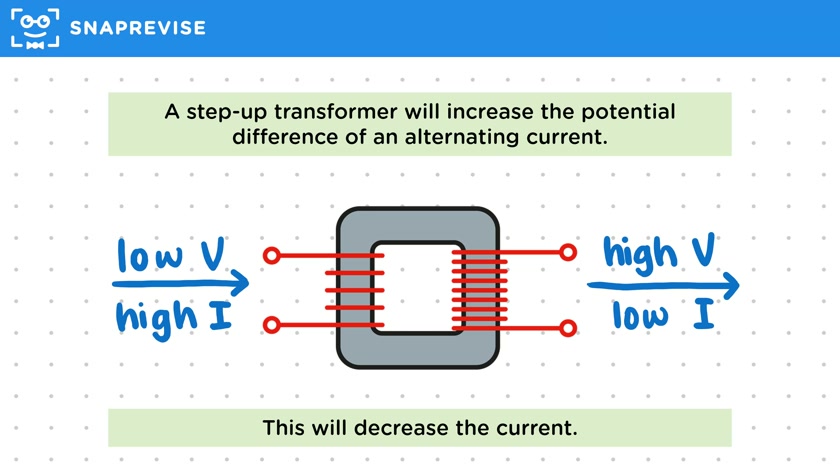
- Step-up transformers increase potential difference; more turns on the secondary coil.
- Step-up transformers result in higher potential difference and lower current.
- Step-down transformers decrease potential difference; fewer turns on the secondary coil.
- Step-down transformers result in lower potential difference and higher current.
- Transformers are designed to minimize energy loss.
- Insulated core and soft iron core reduce energy losses and heating.
- Low resistance wires are used to minimize energy loss to heat.
- Combined science students should understand how transformer design improves efficiency in the national grid.
Please subscribe to access these revision notes.
This, and all other video notes, are included in our premium subscriptions.
Premium accounts get access to all videos and revision notes.
144
questions for Electricity
28
questions for Energy transfers