
GCSE Physics (AQA)
346 videos | 23 hours
Please subscribe to watch this video.
This, and all other videos, are included in our premium subscriptions.
Premium accounts get access to all videos.
Enable autoplay to keep watching
Your browser is blocking videos from playing automatically. To turn it back on:
Safari (Mac): Click the Safari menu item in the top bar, then Settings → Websites → Auto-Play, then set Auto-Play to Allow All Auto-Play for the current website.
Safari (iPhone/iPad): open the Settings app, then Apps → Safari → Auto-Play, and select Allow All Auto-Play.
Uniform Acceleration Equation
- Acceleration is uniform if it remains constant.
- Acceleration measures how velocity changes over time.
- Acceleration can be calculated using the gradient of velocity-time graphs.
- A straight line graph indicates uniform acceleration (constant gradient).
- A curved graph indicates non-uniform acceleration (changing gradient).
- Uniform acceleration occurs when forces on an object are constant.
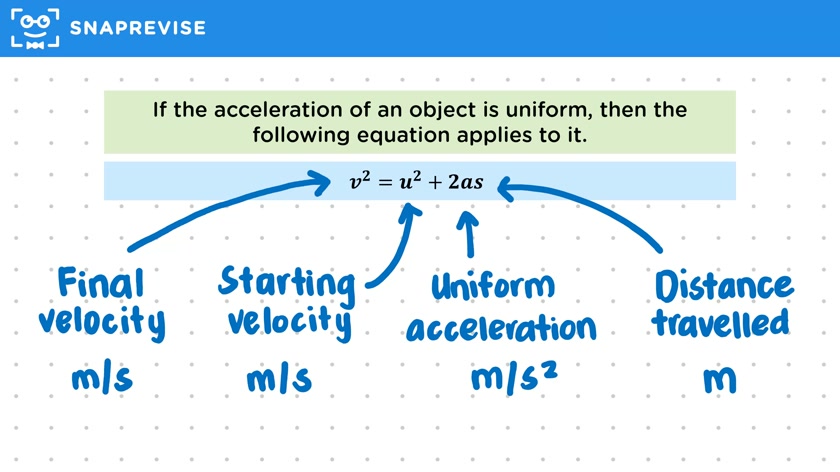
- The equation for uniform acceleration is V�� = U�� + 2as.
- V represents final velocity, U represents starting velocity, a is uniform acceleration, and s is distance traveled.
- The equation is used when acceleration is uniform and forces are constant.
- Example problem: A mouse accelerates uniformly from 1 m/s to 4 m/s over 3 meters.
- Steps to solve: Identify key information, rearrange the equation for acceleration, substitute values, and calculate.
- The calculated acceleration in the example is 2.5 m/s��.
Please subscribe to access these revision notes.
This, and all other video notes, are included in our premium subscriptions.
Premium accounts get access to all videos and revision notes.
153
questions for Forces
98
questions for Forces and motion