
GCSE Physics (AQA)
346 videos | 23 hours
Please subscribe to watch this video.
This, and all other videos, are included in our premium subscriptions.
Premium accounts get access to all videos.
Enable autoplay to keep watching
Your browser is blocking videos from playing automatically. To turn it back on:
Safari (Mac): Click the Safari menu item in the top bar, then Settings → Websites → Auto-Play, then set Auto-Play to Allow All Auto-Play for the current website.
Safari (iPhone/iPad): open the Settings app, then Apps → Safari → Auto-Play, and select Allow All Auto-Play.
Using Solenoids
- Electromagnets are solenoids with an iron core.
- A solenoid is a wire coiled many times, creating a magnetic field when current passes through it.
- The direction of the current determines the direction of the magnetic field and the magnetic poles.
- Inserting an iron core into the solenoid creates an electromagnet, which produces a stronger magnetic field than a solenoid alone.
- Electromagnets are useful in various applications, such as lifting heavy objects like cars with cranes.
- Electromagnets can be turned off by stopping the current, making them more practical than permanent magnets.
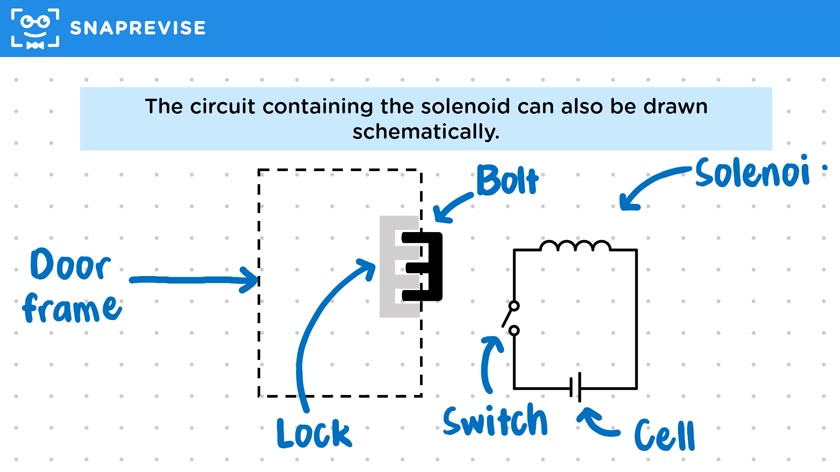
- Electromagnets are used in electronic locks, where they release a door bolt when activated.
- In high current circuits, electromagnets can safely close switches from a distance, reducing the risk of electric shock.
- A relay system uses an iron bar and an electromagnet to safely operate high current circuits.
- Understanding how to interpret circuit diagrams involving solenoids and electromagnets is important for exams.
- Electromagnets are used in applications like electronic bells, alarms, and relays.
- Relays involve a solenoid or electromagnet moving an iron bar to complete a circuit, allowing safe operation of high current systems.
Please subscribe to access these revision notes.
This, and all other video notes, are included in our premium subscriptions.
Premium accounts get access to all videos and revision notes.
99
questions for Magnetism and electromagnetism
41
questions for The motor effect