
GCSE Physics (AQA)
346 videos | 23 hours
Please subscribe to watch this video.
This, and all other videos, are included in our premium subscriptions.
Premium accounts get access to all videos.
Enable autoplay to keep watching
Your browser is blocking videos from playing automatically. To turn it back on:
Safari (Mac): Click the Safari menu item in the top bar, then Settings → Websites → Auto-Play, then set Auto-Play to Allow All Auto-Play for the current website.
Safari (iPhone/iPad): open the Settings app, then Apps → Safari → Auto-Play, and select Allow All Auto-Play.
Waves & Boundaries
- A boundary is where a wave transitions from one medium to another.
- Two media can differ due to different materials or conditions.
- Examples of media include air and glass, a plastic bottle and its contents, or varying water depths.
- The line where two media meet is called a boundary.
- A wave transfers energy without transferring matter and can be a light wave, sound wave, etc.
- When a wave reaches a boundary, several outcomes are possible:
- Transmission: The wave passes into the second medium, potentially changing direction, wavelength, and speed.
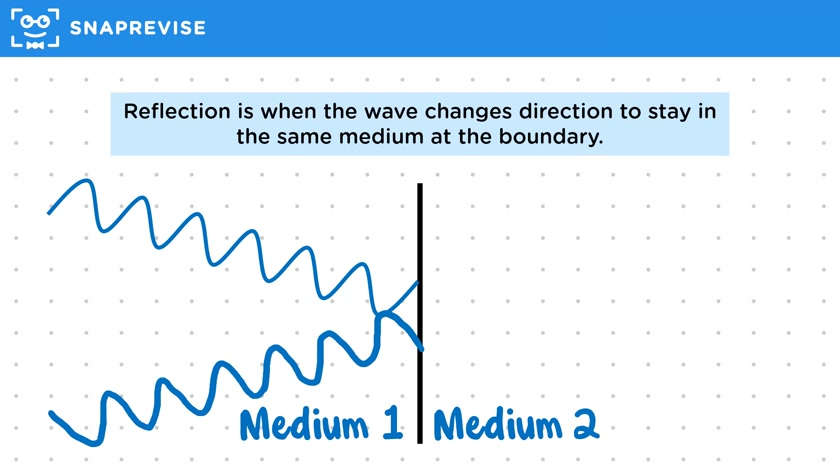
- Reflection: The wave changes direction to remain in the first medium, such as in mirrors or sound echoes.
- Absorption: The wave is stopped at the boundary, with its energy absorbed by the second medium, as in soundproof rooms or ovens.
- Wave energy can be split between transmission, reflection, and absorption.
- Examples include light and frosted glass, where transmission, reflection, and absorption occur simultaneously.
- Reflected and transmitted waves have smaller amplitudes due to less energy.
- Understanding definitions and recognizing these effects is important, but predicting them for specific waves and boundaries is not required for exams.
Please subscribe to access these revision notes.
This, and all other video notes, are included in our premium subscriptions.
Premium accounts get access to all videos and revision notes.
172
questions for Waves
72
questions for Waves in air, fluids and solids