

Topic Summaries
Specific heat capacity and latent heat
Energy and power
Renewable energy and efficiency
Charge, current, and electric fields
Potential difference and resistors
Electricity
Volume and gases
States of matter and heat capacity
Radiation
Nuclear fusion and fission
Forces
Velocity and acceleration
Gravity and Newton's Laws
Moments and elastic potential
Stopping, braking, and momentum
Properties of waves
Electromagnetic waves
Refraction and lenses
Light, colour, and ray diagrams
Absorbing and emitting infrared radiation
Magnetic fields
Motor effect, generator effect, and transformers
Science skills: Experimental procedures
Science skills: Presenting and using data
Science skills: Measuring results
Energy and power
Renewable energy and efficiency
Charge, current, and electric fields
Potential difference and resistors
Electricity
Volume and gases
States of matter and heat capacity
Radiation
Nuclear fusion and fission
Forces
Velocity and acceleration
Gravity and Newton's Laws
Moments and elastic potential
Stopping, braking, and momentum
Properties of waves
Electromagnetic waves
Refraction and lenses
Light, colour, and ray diagrams
Absorbing and emitting infrared radiation
Magnetic fields
Motor effect, generator effect, and transformers
Science skills: Experimental procedures
Science skills: Presenting and using data
Science skills: Measuring results
- The change in thermal energy associated with a temperature change in a system is given by \(\text{energy}=\text{mass}\times\text{specific heat capacity}\times\text{temperature change}\) or \(\Delta E=mc\Delta\theta\).
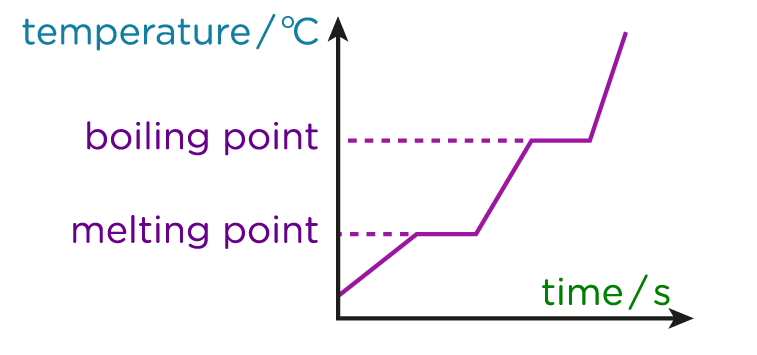
- When heating a substance as it is changing state, its internal energy will increase but its temperature will not change. This can be noticed on a heating or cooling graph for the substance.
- The specific latent heat of a substance is the energy required to change the state of one kilogram of the substance without changing its temperature.
- The specific latent heat of fusion is the specific latent heat for changing the substance from solid to liquid.
- The specific latent heat of vaporisation is the specific latent heat for changing the substance from liquid to gas.
- The energy required to change state is given by \(\text{energy}=\text{mass}\times\text{specific latent heat}\). This can be written as \(E=mL\) where:
- \(E\) is the energy required to change state in J
- \(m\) is the mass of the substance in kg
- \(L\) is its specific latent heat in J/kg
Unlock Specific heat capacity and latent heat
Subscribe to SnapRevise+ to get immediate access to the rest of this resource.
Premium accounts get immediate access to this resource.