
GCSE History (AQA)
Topic Summaries
Medieval medicine
Medieval doctors and medical professionals
- Physicians: university-trained for seven years, expected to provide diagnoses (limited to taking pulses and examining the colour, smell, and taste of urine). They learnt mainly by listening to lectures and debating ideas, often graduating without ever seeing a patient. They were the highest status medical practitioners and were very expensive.
- Apothecaries: mixed and sold herbal remedies, including poisons. They were disliked by physicians as they offered much cheaper treatments.
- Barber surgeons: were lower-class medics who could perform basic surgery by learning through experience. Common procedures included:
- Bloodletting: making a small cut on the inside of the arms and letting ‘excess’ blood drain out in order to balance the humours.
- Amputation: removing a painful or infected part of the body.
- Cauterisation: a very painful method of burning a wound to stop the blood flow, done with a heated iron.
- Drilling: some conditions like epilepsy were believed to be caused by demons in the brain, so a surgeon would drill a hole into the skull.
- Women: cared for the sick at home but couldn’t become doctors.
Profile: Hippocrates
- Hippocrates was an ancient Greek doctor often described as the ‘Father of Medicine.’
- He believed that diseases had natural causes rather than being sent by God as punishment.
- Hippocrates developed the Theory of the Four Humours, which stated that health depended on a balance of blood, phlegm, black bile, and yellow bile.
- He also established the Hippocratic Oath, a set of ethical guidelines for doctors.
- Hippocratic treatments focused on restoring balance through diet, exercise, and bloodletting.
- His ideas represented an important early move away from supernatural explanations, although Hippocrates’ work was limited by a lack of scientific knowledge and technology and adherence to his ideas stifled progress for centuries.
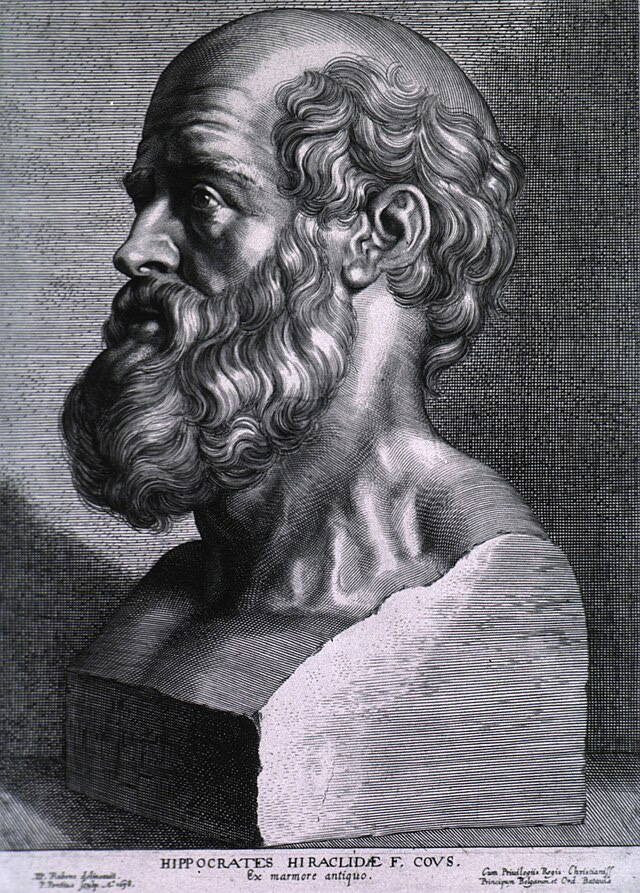
Hippocrates
(b. ~460 BCE, d. ~375 BCE)
Profile: Galen
- Galen was a physician whose ideas dominated European medicine for 1,400 years.
- He expanded Hippocrates’ Theory of the Four Humours and developed the Theory of Opposites about how to balance the humours.
- Like Hippocrates, Galen prescribed treatments such as purging and bloodletting.
- He was also an advocate for animal dissections as a means of learning about anatomy, as human dissection was banned in Ancient Rome.
- His work was highly respected because it aligned with Christian beliefs and was supported by the Church. However, Galen’s ideas also acted as a barrier to progress because they discouraged questioning and experimentation even though some of his findings were incorrect; for example, he thought blood was made in the liver.
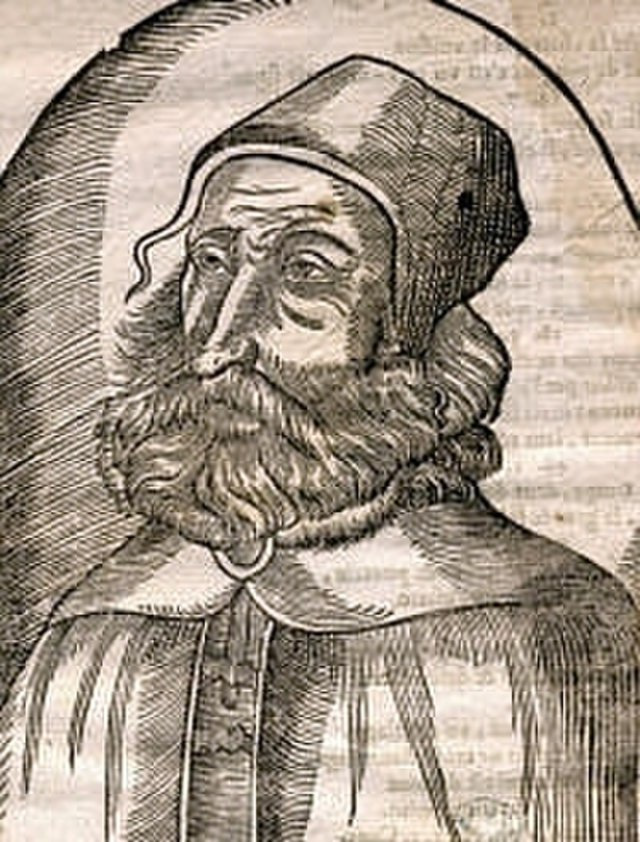
Galen
(b. 129 CE, d. 216 CE)
Profile: Abu Bakr al-Razi (Rhazes)
- Al-Razi was a leading Persian physician who made important advances in clinical medicine and wrote over 150 books on the subject.
- He was one of the first doctors to clearly distinguish between smallpox and measles.
- Al-Razi prioritised observation, experimentation, and recording symptoms. He supported hospital-based care and believed doctors should rely on evidence rather than authority.
- He was a follower of Galen but actively challenged many of his ideas; one of his books was called ‘Doubts about Galen.’
- His work encouraged a more scientific approach to medicine and set the foundations for psychology, though it spread slowly to Europe
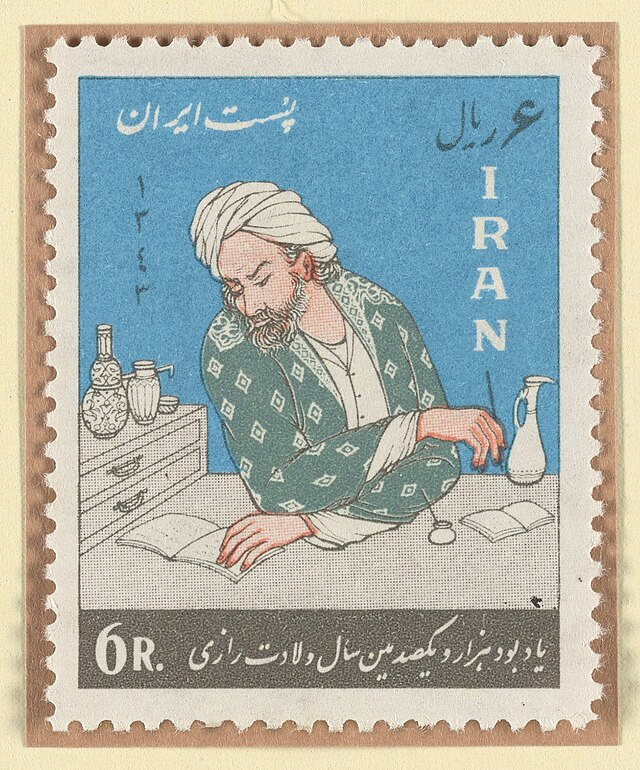
Abu Bakr al-Razi
(b. ~864 d. ~925)
Profile: Ibn Sina (Avicenna)
- Ibn Sina was a Persian physician whose medical knowledge had a major influence on medieval Europe.
- He wrote The Canon of Medicine, which became a standard medical textbook for centuries.
- It contained information on 760 drugs, and problems such as obesity and anorexia.
- The first Latin translation of the Canon of Medicine appeared in the twelfth century. Top universities in Italy soon started using these books to teach medicine.
- Ibn Sina supported the Theory of the Four Humours but also emphasised careful diagnosis and observation.
- His work preserved and developed ancient Greek medical knowledge during the Islamic Golden Age.
- Islamic views on illness differed to that of Christianity at the time: Islam encouraged medical learning, with followers being taught ‘For every disease, God has given a cure.’
- The Canon improved medical education but also reinforced traditional ideas that limited progress.
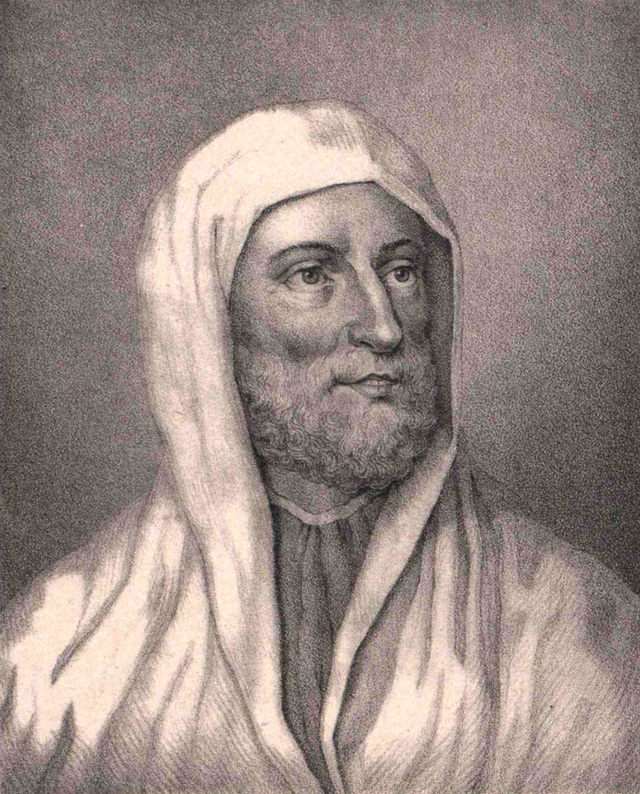
Ibn Sina
(b. ~980 d. 1037)
Profile: Hugh of Lucca and Theodoric of Lucca
- Hugh of Lucca was a medieval Italian surgeon who challenged traditional ideas about wound treatment. His son, Theodoric of Lucca, recorded and spread these ideas through medical texts.
- Hugh rejected the belief that pus was a sign of healing and instead promoted cleaning wounds thoroughly. He encouraged the use of clean dressings and careful wound management.
- Their 1267 book criticised the common view that pus was needed to heal a wound, instead recommending the use of wine on wounds to speed up healing and prevent infections.
- Despite being ahead of their time in methods of reducing infection, their ideas contradicted Hippocratic and Galenic teachings so did not become popular
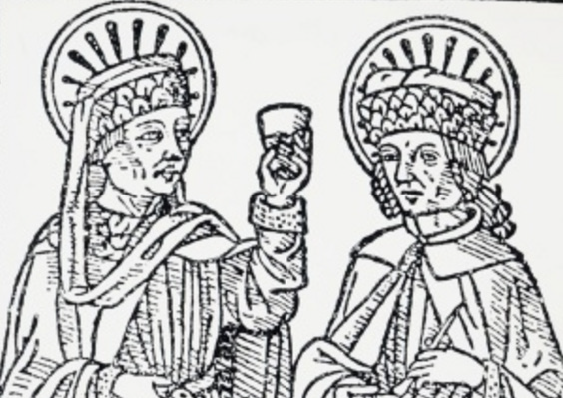
Hugh of Lucca (b. 1160 d. ~1256) and
Theodoric of Lucca (b. 1205 d. ~1296)
Profile: John of Arderne
- John of Arderne was a medieval English surgeon who made important advances in surgical practice.
- He is best known for developing treatments for anal fistulas, a condition common among knights. He charged large fees to treat these abscesses in knights.
- Arderne emphasised practical experience and careful observation rather than blind reliance on ancient texts. His illustrations were based on Greek and Arab knowledge during the Hundred Years War.
- He believed in pain relief and used opium-based anaesthetics to reduce suffering during surgery. His work helped improve the reputation of surgeons, who were often viewed as inferior to physicians.
- He tried to separate surgeons from lower-class barbers by forming The Guild of Surgeons in the City of London in 1368.
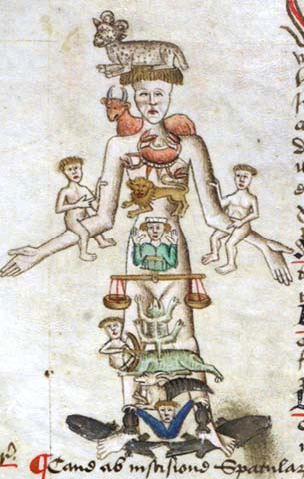
John of Arderne
(b. 1307 d. 1392)
a medical drawing of astrological/zodiac signs and associated organs
Unlock Medieval doctors and medical professionals
Sign up to unlock the rest of this topic — plus every other topic, video, flashcard set and eBook guide in your SnapRevise Digital subscription.
Cancel anytime — instant access the moment you sign up.
Report an Issue
Spotted something wrong? Let us know and we'll take a look.