

Elizabethan England Topic Summaries
The question of succession
GCSE
>
History
>
WJEC
>
GCSE History: Elizabethan England (1558-1603)
>
Elizabeth’s accession
>
The question of succession
Elizabeth’s accession
- - Social structure 1588 England
- - Elizabeth I’s background
- - Elizabeth I’s character strengths
- - The coronation of Elizabeth I
- - Elizabeth’s legitimacy and early challenges
- - Government structure
- - Life at court
- - The Privy Council
- - Profile: William Cecil, 1st Baron Burghley
- - Profile: Robert Cecil, 1st Earl of Salisbury
- - Profile: Francis Walsingham
- - Profile: Robert Dudley, 1st Earl of Leicester
- - Profile: Robert Devereux, 2nd Earl of Essex
- - Profile: Thomas Howard, 4th Duke of Norfolk
- - Factions, allies, and rivalries in the Privy Council
- - The Puritans and Parliament
- - Propaganda and royal image
- - The question of marriage
- - The question of succession
- - Challenges at home and abroad
- - Essex’s rebellion
Elizabethan life and culture
- - The golden age
- - Growing prosperity and the rise of the gentry
- - The role of the theatre
- - Education
- - Family life
- - Sport, art, and other pastimes
- - Puritan opposition to ‘Merry England'
- - Persecution of witches
- - Socio-economic status
- - Reasons for increased poverty and vagabondage
- - Responses to poverty
Religious challenges and plots
Imperial ambitions
Conflict with Spain
Elizabeth’s accession
- - Social structure 1588 England
- - Elizabeth I’s background
- - Elizabeth I’s character strengths
- - The coronation of Elizabeth I
- - Elizabeth’s legitimacy and early challenges
- - Government structure
- - Life at court
- - The Privy Council
- - Profile: William Cecil, 1st Baron Burghley
- - Profile: Robert Cecil, 1st Earl of Salisbury
- - Profile: Francis Walsingham
- - Profile: Robert Dudley, 1st Earl of Leicester
- - Profile: Robert Devereux, 2nd Earl of Essex
- - Profile: Thomas Howard, 4th Duke of Norfolk
- - Factions, allies, and rivalries in the Privy Council
- - The Puritans and Parliament
- - Propaganda and royal image
- - The question of marriage
- - The question of succession
- - Challenges at home and abroad
- - Essex’s rebellion
Elizabethan life and culture
- - The golden age
- - Growing prosperity and the rise of the gentry
- - The role of the theatre
- - Education
- - Family life
- - Sport, art, and other pastimes
- - Puritan opposition to ‘Merry England'
- - Persecution of witches
- - Socio-economic status
- - Reasons for increased poverty and vagabondage
- - Responses to poverty
Religious challenges and plots
Imperial ambitions
Conflict with Spain
- Elizabeth nearly died of smallpox in 1562. Her Privy Council advisors were concerned about who would succeed her when she died, since she had no husband or children.
- Memories of the Wars of the Roses made people fear civil conflict if the succession was uncertain, so Parliament repeatedly urged Elizabeth to marry and name an heir, which she resented.
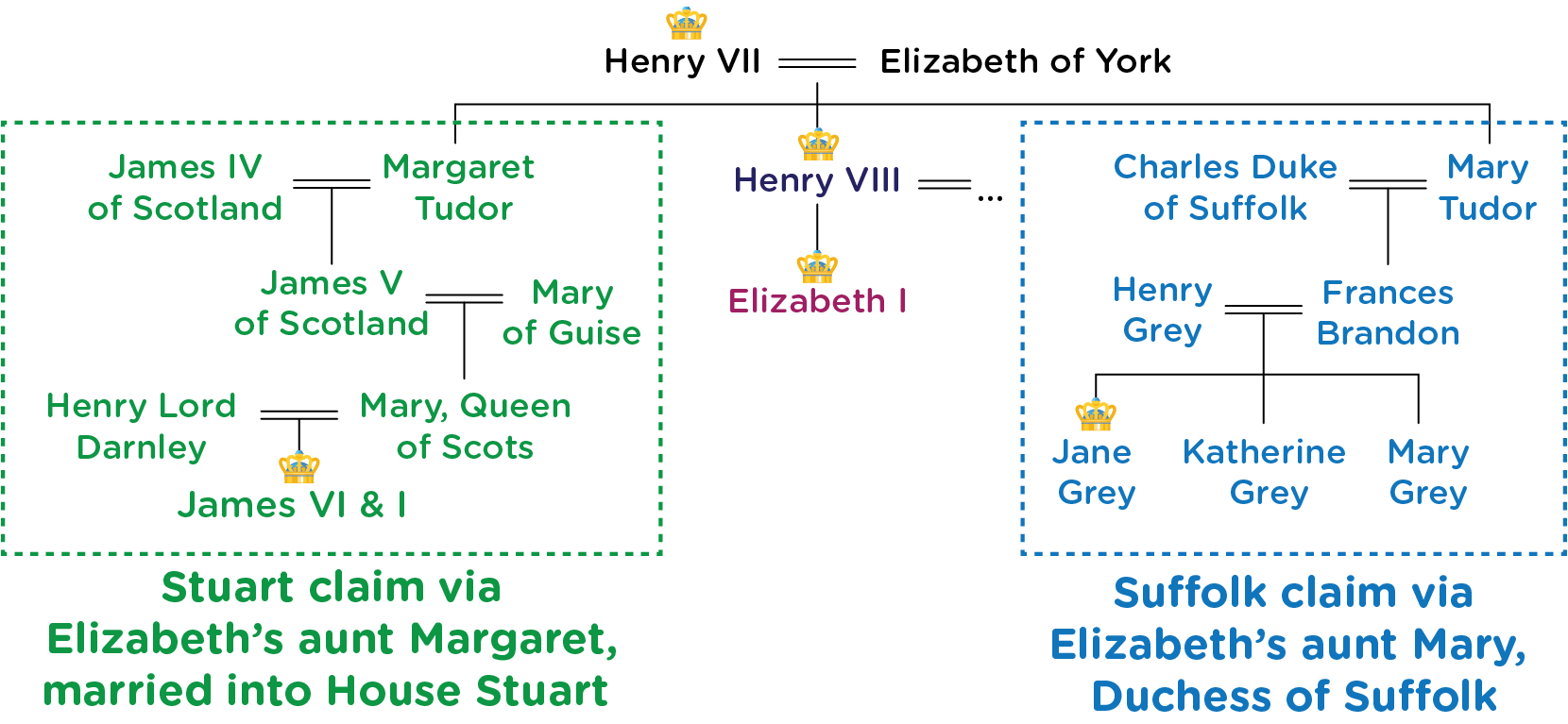
- The Suffolk Claim:
- Lady Jane Grey, Elizabeth’s cousin, had previously tried to claim the throne in 1553 and was the disputed Queen for 9 days before being deposed and executed by Mary I.
- Her sisters, Catherine and Mary Grey, were both Protestants and considered possible successors. However, both women married without Elizabeth’s approval, which led to their imprisonment. As a result, Elizabeth removed them from the line of succession.
- The Stuart Claim:
- Mary, Queen of Scots, had a powerful claim to the English throne through her descent from Henry VIII’s older sister Margaret, who had married into the Scottish royal family.
- Raised in Catholic France, Mary was seen as a threat to Protestant England. She strengthened her position further by marrying her cousin, Lord Darnley, who also had royal blood through Margaret Tudor, giving her more claim to both thrones.
- Elizabeth eventually ordered Mary’s execution in 1587.
- Mary and Lord Darnley had a son, James VI of Scotland, who would eventually unite the crowns and also become James I of England after Elizabeth’s death. This ended the Tudor dynasty.
- Although James VI was never named as heir, Robert Cecil secretly negotiated with James VI in the final years of Elizabeth’s reign to facilitate a stable, peaceful succession.
Unlock The question of succession
Subscribe to SnapRevise+ to get immediate access to the rest of this resource.
Premium accounts get immediate access to this resource.