
GCSE Maths (Edexcel)
435 videos | 33 hours
Please subscribe to watch this video.
This, and all other videos, are included in our premium subscriptions.
Premium accounts get access to all videos.
Enable autoplay to keep watching
Your browser is blocking videos from playing automatically. To turn it back on:
Safari (Mac): Click the Safari menu item in the top bar, then Settings → Websites → Auto-Play, then set Auto-Play to Allow All Auto-Play for the current website.
Safari (iPhone/iPad): open the Settings app, then Apps → Safari → Auto-Play, and select Allow All Auto-Play.
Advanced Quadratics - Splitting Method
- Some quadratics with coefficients of X squared greater than one can be factorized using the splitting method
- The linear X term is split into two added terms
- The coefficients of these terms need to multiply together to give the same number obtained from multiplying the coefficient of the X squared term and the constant term
- The split terms need to multiply together to give the product of the X squared coefficient and the constant term
- Quadratics with coefficients of X squared greater than 1 can also be factorized using inspection
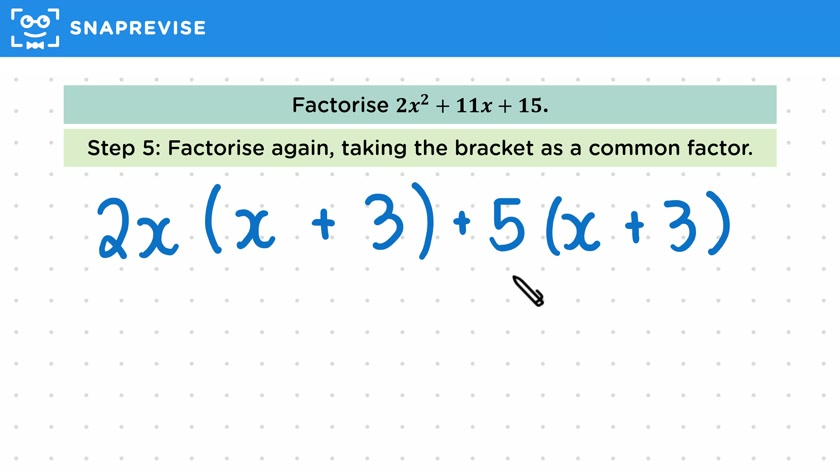
- Example: Factorize 2x squared plus 11x plus 15
- Step 1: Find the product of the X squared coefficient and the constant term (2 times 15 = 30)
- Step 2: Split the X term into two terms that multiply to the previous product (6x and 5x)
- Step 3: Factorize the first two terms (2x squared plus 6x)
- Step 4: Factorize the last two terms (5x plus 15)
- Step 5: Factorize again, taking the bracket as a common factor (x plus 3 times 2x plus 5)
- Another example: Factorize 3x squared minus 16x minus 12
- Step 1: Find the product of the X squared coefficient and the constant term (3 times -12 = -36)
- Step 2: Split the X term into two terms that multiply to the previous product (-18x and 2x)
- Step 3: Factorize the first two terms (3x times x minus 6)
- Step 4: Factorize the last two terms (2x minus 6)
- Step 5: Factorize again, taking the bracket as a common factor (x minus 6 times 3x plus 2)
Please subscribe to access these revision notes.
This, and all other video notes, are included in our premium subscriptions.
Premium accounts get access to all videos and revision notes.
310
questions for Algebra
100
questions for Notation, vocabulary and manipulation