
GCSE Maths (Edexcel)
435 videos | 33 hours
Please subscribe to watch this video.
This, and all other videos, are included in our premium subscriptions.
Premium accounts get access to all videos.
Enable autoplay to keep watching
Your browser is blocking videos from playing automatically. To turn it back on:
Safari (Mac): Click the Safari menu item in the top bar, then Settings → Websites → Auto-Play, then set Auto-Play to Allow All Auto-Play for the current website.
Safari (iPhone/iPad): open the Settings app, then Apps → Safari → Auto-Play, and select Allow All Auto-Play.
Alternate Angles
- Alternate angles are formed when two lines are crossed by a transversal line
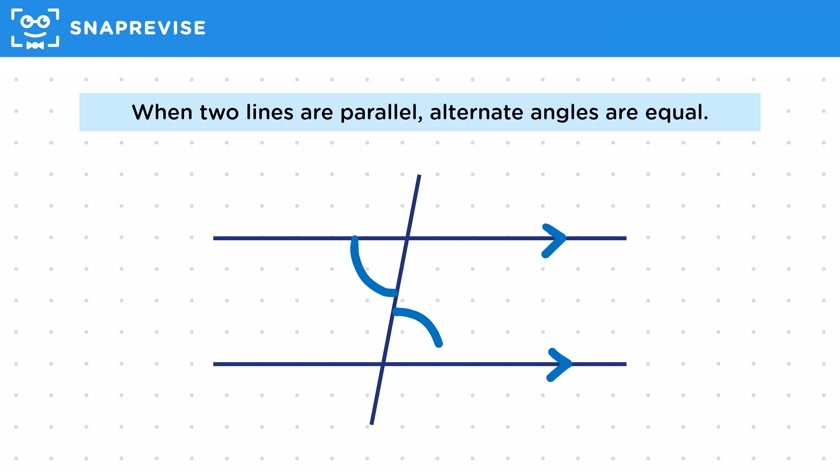
- Alternate angles are formed on opposite sides of the transversal
- Alternate angles can be recognized by their characteristic Z shape
- When two lines are parallel, alternate angles are equal
- Parallel lines never meet even when extended to infinity
- Knowing that one alternate angle is a certain degree can help determine the degree of the other alternate angle
- The reason why alternate angles are equal when two lines are parallel is because they correspond to vertically opposite angles
- In an example problem, the missing angle can be found by using the fact that alternate angles are equal for parallel lines
Please subscribe to access these revision notes.
This, and all other video notes, are included in our premium subscriptions.
Premium accounts get access to all videos and revision notes.
372
questions for Geometry and measures
164
questions for Properties and constructions