
GCSE Maths (Edexcel)
435 videos | 33 hours
Please subscribe to watch this video.
This, and all other videos, are included in our premium subscriptions.
Premium accounts get access to all videos.
Enable autoplay to keep watching
Your browser is blocking videos from playing automatically. To turn it back on:
Safari (Mac): Click the Safari menu item in the top bar, then Settings → Websites → Auto-Play, then set Auto-Play to Allow All Auto-Play for the current website.
Safari (iPhone/iPad): open the Settings app, then Apps → Safari → Auto-Play, and select Allow All Auto-Play.
Circle Theorem Problems
- Circle theorems can be used to calculate unknown angles and lengths in circles
- The angle at the circumference of a circle is half the angle at the center if they are formed by the same arc
- The distance from a meeting point of two tangent lines to the circle is the same for both tangent lines
- Every angle formed in a semicircle is equal to 90 degrees
- Opposite angles in a cyclic quadrilateral add up to 180 degrees
- Twin angles, subtended by the same arc, are equal to each other
- The angle between a tangent line and a chord in the alternate segment of a circle is equal to any angle subtended by that chord
- Exam questions may require the use of multiple circle theorems to solve geometric problems
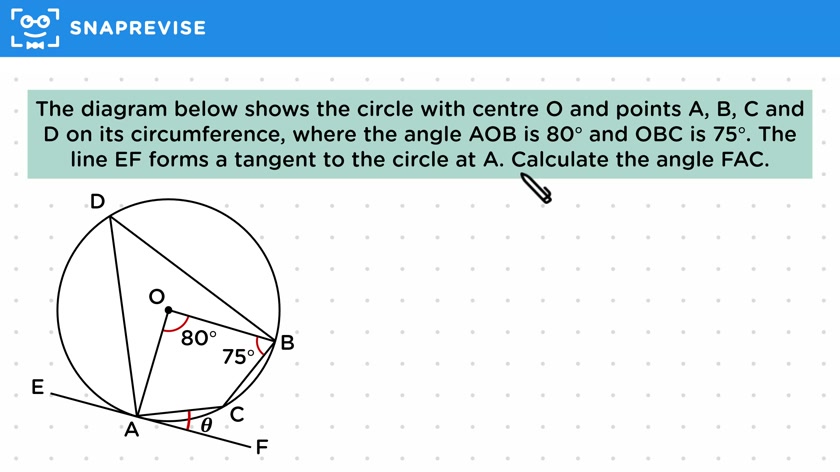
- In the given example, angle FAC can be calculated by combining multiple circle theorems
- Angle ADB is half of angle AOB, which is 40 degrees
- Angle ACB is the opposite angle of ADB in the cyclic quadrilateral, so it is 140 degrees
- Angle OAC in quadrilateral OBCA is 65 degrees
- Angle FAC is the difference between 90 degrees and 65 degrees, which is 25 degrees
Please subscribe to access these revision notes.
This, and all other video notes, are included in our premium subscriptions.
Premium accounts get access to all videos and revision notes.
372
questions for Geometry and measures
164
questions for Properties and constructions